"The goal is to become the unique, awesome, never to be repeated human being that we were called to be." -Patricia Deegan

Monday, August 5, 2019

Via Valais: A Suggested Haute Route for Trail Runners

Over the winter, I came across a mention of the Via Valais in my Swiss trail magazine, Die Alpen. It's a suggested 9 day "high route" for trail runners, akin to what skiers and hikers have. I was intrigued.

I've been running hiking "haute routes" in fastpacking style for years in the European alps. Presumably, this chosen route would be designed to be more running friendly in terms of grade than a "haute route" for hikers. As they wrote on their website, it would "traverse" in and out of valleys rather that go straight up and down.

Well, as I discovered, in the Valais region of French-speaking Switzerland, even a "traverse" often has a pretty steep grade! When you want to get from col or summit to the valley and up the other side, there's going to have to be elevation. "Runnable" is a very relative term! Let's dive in....
The faint green shows the route. Going west to east, you essentially valley hop.
The route goes from a cable car station above Verbier to Zermatt over 9 stages. I decided to have my adventure end at the village of Randa - the end of Stage 7. I ran the trails from Randa into Zermatt last year. They are stellar - some of the best - with some of the best views. I didn't feel the need to do it again so soon. And Zermatt is a busy place. Seven days was enough for me.

Arcteryx 14ltr -added cords for more storage
Then I considered how to compress two stages into one to give myself one very long day out in the middle somewhere. I'm not too good at sitting around huts and I like to challenge myself. I chose to combine Stages 3 and 4. By the end of Stage (Day) 1, however, I was a bit concerned about my idea!

It's always best to book your spot at a cabane (hut/refuge) in advance, which I'd done. Most only take cash. I had gpx courses loaded on my Garmin 920XT.

Day 1 (Stage 1): Les Ruinettes (~2200m) to Cabane D'Essertze (~2200m), advertised as 29km +/-1120m. I had a leisurely start and was at the top of the cable car at 10am with a good, stable forecast for a week. That's critical for this high alpine stuff and hard to find in summer! But going early in the season would require more gear and would pose more risks with lingering angled snow fields to cross. And some via ferrata (with ladders) might not be put in yet for the summer season if there's still a risk of avalanche onto it.

Given at least 7kg on my back, I figured the day would take me 6 - 7 hours with a nice lunch stop along the way. It was, indeed, 7 hours, but there was only a frantic inhaling of a torte myrtille (blueberry tart) and Schorle (sparkling apple juice) mid-afternoon. That took a matter of a few minutes. I was also "off trail" for a good 30 minutes of the day. I needed to learn that "wanderwegs" (sentiers/trails) often change each year, especially in glaciated areas. Winter snow and spring run off, with accompanying landslides, can dramatically alter a landscape, causing trails to be rerouted through an area. I reached the first of such places about 3 hours into my day and spent over 20 minutes having left the marked red-and-white trail, following my gpx, which was trying to have me cross a very fast flowing glacial run-off. After a few attempts at starting across, and then trying numerous other places to ford the dangerous water, I finally turned back to try following the red-and-white markers. Sure enough, they went all the way around the outside of this area and then reconnected with the gpx route on the other side. First lesson learned. I was much better prepared later in the day when I came to a landslide. My gpx said go straight on, but I noted the red-and-white blazes on the rocks had me turning left. I started following the gpx - with my radar on alert this time - only to realise there had been a huge landslide and the trail was rerouted this year to pass below it.

A savvy trail runner in these parts needs to appreciate this aspect of running with gpx files - maintain situational awareness, understand the lay of the land and why routes might need to vary after a hard winter/spring. My 30k day was in fact 33k. My average pace was thus 12.50min/k (I don't stop my watch when I pee, eat, etc - this helps me appreciate the reality of timing for future runs.)

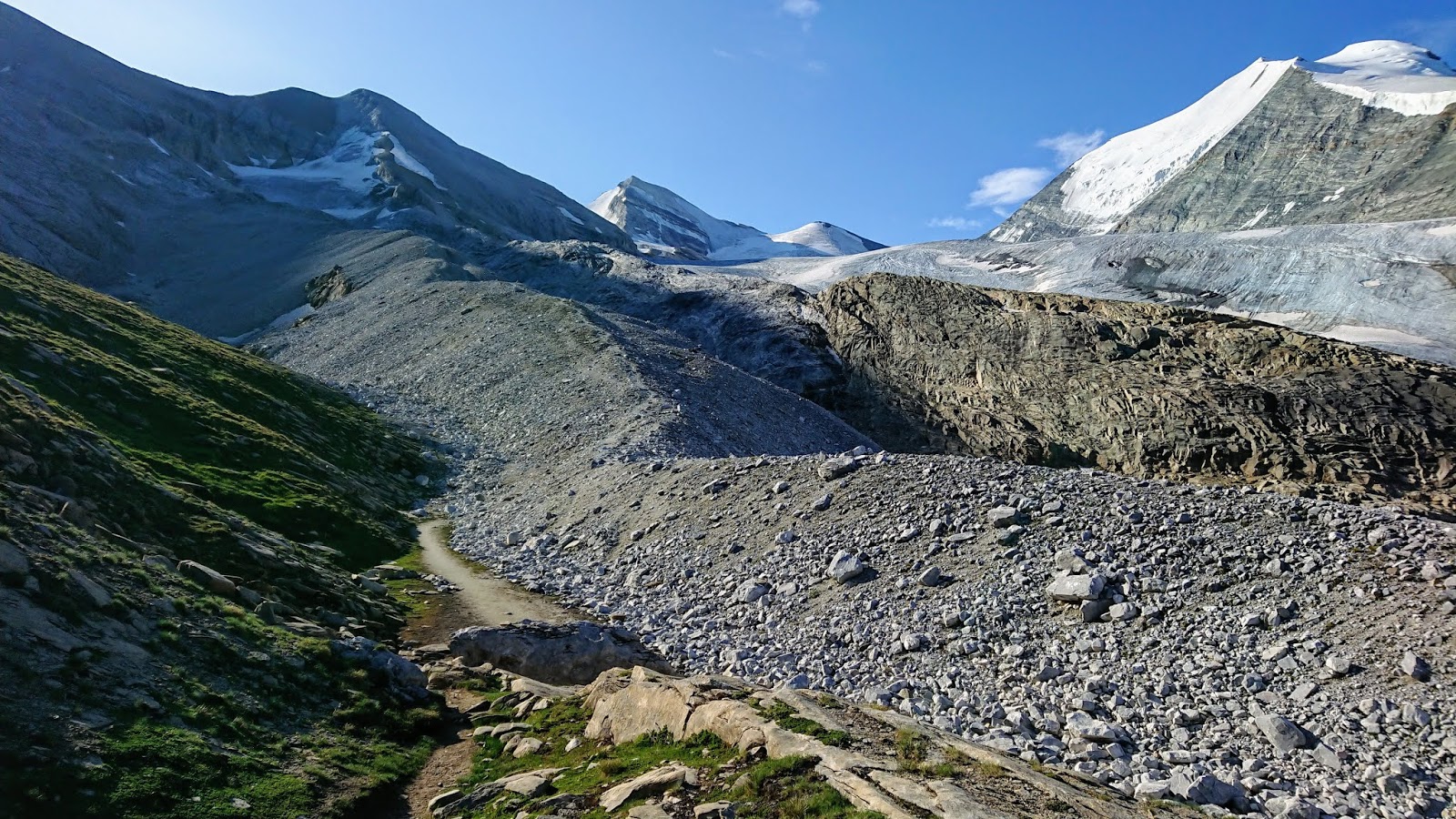
A "trail" on Stage 1, headed for Col de Louvie at 2921m. Boulder fields are also very slow, but there's a reward coming!
Much of Stage 1's "claim to fame" is supposed to be running on "bisse" trails - "old irrigation ditches that tend to be silky smooth for running" according to the website. A half truth. Every bisse trail I can recall was super narrow, with small trippy rocks, and also sometimes 'grooved' out in a trench. They were annoyingly slow for running. I passed a couple of Alaskan/Seattle American trail runners on a snow descent section and met them later at the hut. They said they had been "crushed" by the stage.

Reward for reaching a col - stunning new views and snow descent! Below is where I tried to cross the raging torrent.
The hut at day's end was run privately by a mixed French-Canadian/Swiss-French family. They were incredibly welcoming, organised, relaxed but efficient, and really sought to give me vegan options for dinner, breakfast, and my take-away "pique-nique" the next morning. Their prices were the best, as well. They have a road up to their place, which means they aren't paying a helicopter to deliver supplies and remove waste. And their water was potable - a bonus in not having to get out the water filter. They even discounted my picnic because I didn't take the usual meat and cheese! I made almond butter and jam sandwiches (I brought 3 sachets of almond butter for this purpose.)

Cabane D'Essertze
Day 2 (Stage 2): Cabane D'Essertze (~2200m) to Cabane Aiguille Rouge (~2800m), advertised as ~30km + 1800m - 1200m. Putting on my shoes outside the hut at 8am, I chatted briefly to two German (or Swiss-German?) girls who had also run the first stage the day before. They decided the days seemed far too much for them and were going to start adjusting them to suit, starting by breaking Stage 2 in half. I never saw them again.

This stage was much more runnable than Stage 1, however, and I was done in 6.5 hours. A 12:12min/k average. But there was still no lingering lunch stop. I clocked 31.5k + 1545m - 1000m. A key feature of this day was the Pas de Chevres (Pass of the Goats). It involved a set of 4 connected ladders, which you reach via a scramble over a moraine with some giant boulders. Awesome slightly scary fun.

Enroute to becoming a goat.
An unfortunate aspect of cols/passes/saddles is that everyone has the same idea - stop at the top for summit sandwiches :) This is an unfortunate thing for me, as an introvert. This section was also shared with a Cicerone guide book "haute route" for hikers. I thought I'd landed in England at the top and heard the word "bollocks" far too many times in a minute - and there were no goats involved ;) I decided I'd enjoy my summit sandwich without having to hear people discussing whether they could get mobile reception or not, so I headed downhill.

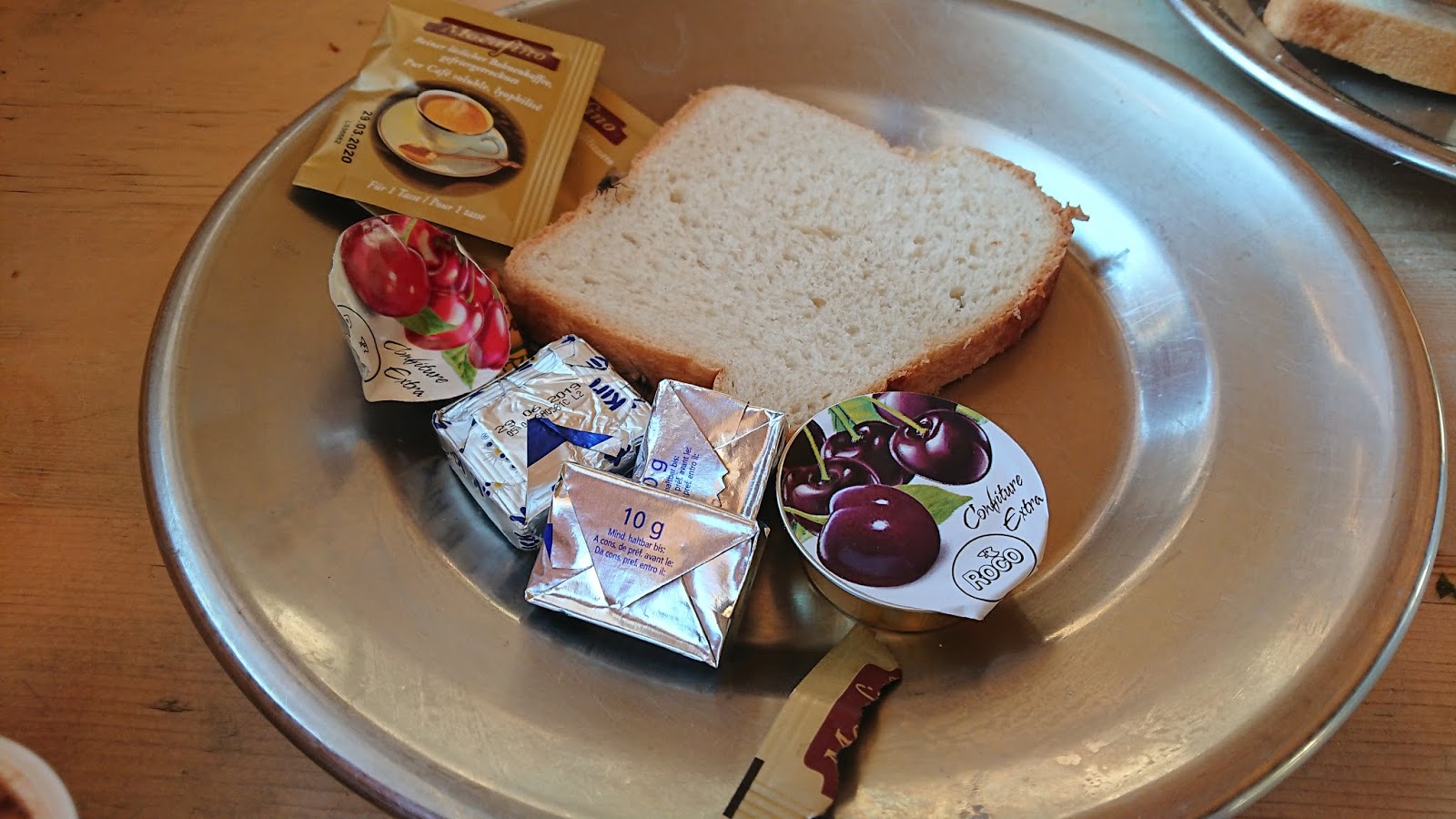
Cabane Aiguille Rouge is also privately owned (i.e., not a Swiss Alpine Club/SAC hut). I've met gruff and grumbly hut wardens before, but he was one of the best. It was not a nice atmosphere inside for any of the guests. There was an air of silence inside, uncommon in most huts. I was on the trail by 7.40am the next day, after one of the worst breakfasts possible at a hut. Not a place to hang out. The American trail runners had come in two hours after me. I write that not to boast, but to try to make it very clear that this route is TOUGH. They were also jetlagged, which wasn't helping them.

Stale white bread, usually restricted to the highest alpine huts. Jam, butter, instant coffee, 1 tea, and 1 choco-sugar drink.
Day 3 (Stage 3 and 4 combined, minus a few km): Cabane Aiguille Rouge (~2800m) to Cabane Becs de Bosson (~3000m) 25km + 2220m - 2050m and Cabane Becs de Bosson to Cabane De Moiry (~2825m) 17km + 870m - 1025m.

I had decided on a long day, combining these two stages. However, given the average pace seemed to be over 12min/k, I realised this long day could very well be 10 hours. Thus, by looking at the maps, I noted that I could get to within 2km of the Becs de Bosson hut, but skip it. I went through the same terrain, but stayed just below the hut, cutting off roughly 2km from each stage, so 4km in total. I was really happy with my choice.
Leaving Aiguille Rouge starts with a bit of great moraine before the steep drop around the bend to the right.
The day started with a super long, steep descent from Aiguille Rouge. I couldn't afford to smash my shins up by letting loose. This wasn't a one day outing. My legs were feeling the vert of two days and jostling down the gnarly track with the big pack on my back didn't help my pace any! It was over 11min/k. We were in the middle of a heat wave. I was starting each day in a short sleeve t-shirt, even from 2900m! Arriving at the valley floor in the lovely historical little village of Evolene had me racing around filling my arms with fruit and cold beverages. It was apricot season. I'm sure I smelled and looked like a wild animal.

From the low point of 1371m, I had to climb back out towards the Pas de Lona at 2787m, under the Cabane Becs de Bosson. It was during this climb towards the Becs de Bosson that I made a right at a fork in order to skip the hut. I felt an initial sense of unease at not having a gpx track on my watch anymore, but that was quickly followed by a feeling of total relaxation and freedom. Suddenly, I didn't have a "route" that I "had" to follow anymore. I could pick and choose where, when, and how to go. Total freedom! Not following anyone else's rules - woohoo! I immediately realised how odd it was that I had felt a subconscious pressure to do the exact "correct" route given by the Via Valais team online. But, really, who cares? Why? I've always made up my routes in the past for fastpacking and loved them. I've been able to be flexible to change as I went along. I had unwittingly made a rule in my head that said if I didn't follow their route, I was somehow "slack" or "wrong." Whose adventure was this, anyway? :)

Lac de Lona from near the pass. Headed into the valley ahead where Lac de Moiry is.
Arriving at Pas de Lona, I gave a nod to the cabane above to my left and joined the gpx track for Stage 4. The landscape changed on the high plateau and the colours were fantastic. I enjoyed a long runnable descent past Lac de Lona, then a short climb to a col next to Sex de Marinda (sex means rock), and another long descent to Lac de Moiry (a dam). After a flat run alongside the lake, I had the last climb along a moraine, then a bit of via ferrata and some slightly precarious sloped snow crossings to get to Cabane de Moiry. In 8.5 hours I covered ~41km +/- 2540m. Average pace 12.31. There's a theme here.

A pleasant run along Lac de Moiry, headed for the cabane, which is above left of that "black hole" in the glacier ahead.
I had my first chance for a shower (most huts don't have the option), so paid the 5CHF for 5 minutes. I got out and my feet still stunk. Shower fail. Despite being right beside a huge glacier at 2825m, it was so hot! My evening attire (i.e., my only set of clean clothes) was long johns and it was too hot for those, so I had to put my CEP running shorts back on for the evening. No trail runners sighted, but climbers were here to do the surrounding peaks.

Each stage has a suggested "bonus peak." I hadn't done any thus far and was keen on Pigne de la Le (3396m), the peak behind the cabane. It was listed on Via Valais' website as "easy ridge scrambling." The two climbers I met at the hut during dinner talked me out of it. I know the ease of routes changes depending on time of year and conditions and everyone has a different risk/comfort level, but based on what they said, it sounded like Type 3 fun. Especially being alone.

My view for the evening, with the "black hole" in the glacier now below me.
Day 4 (Stage 5): Cabane de Moiry (~2825m) to Zinal (~1600m). Advertised as 24km + 1064m - 2215m. Breakfast at this cabane was offered between 5.30am and 7.30am. No one's sleeping in there. After leaving the cabane, I traversed and climbed up to Col de Sorebois (2850m). Sweat was dripping off me and it wasn't even 10am. At the pass, the next valley appeared below - Val d'Anniviers, with Zinal as the destination. There's a handy-dandy cable car right there, ready to take people down. And the cabane even offered a free pass for the cable car with every stay! (A special promotion being done by the Val d'Anniviers communities this year.) But I was in no hurry to get to Zinal and couldn't bear the thought of missing my promised "incredible views of Zinalrothorn, Weisshorn, and Dent Blanche." I was committed to doing the long traverse into town instead. I did enjoy an espresso at the cable car station first.

And a long traverse it was! It went up before it went down, there were lots of narrow bits, and when it did finally go down, my right shin let me know it was getting tired of all these shenanigans. The waterfall was the highlight and welcome in the heat. I spent some time setting up a selfie photo and didn't mind all the water spray at all. The last section of downhill was another super steep bit, with water in the area, causing vegetation to thrive. Much of the trail was overgrown and it was hard to see my footing. Nettles are a real pain for me, as I react really badly, so that added to my challenge in that section. I felt like I was trying to run in an overgrown ditch.

Highlight of traverse: crossing a waterfall - the rope was prudent, given the water flowing over the rocks under foot.
Surprisingly, my Garmin actually agreed with the distance advertised. I got 24km, but with slight variations in vert (+890m - 1980m), and I was out there 5.25 hours, which included for the first time a proper 15 minute sit-down picnic at Sorebois. Average pace was therefore 13min/k. There's so much terrain in this route that I sure wouldn't want to be on in the rain or in a whiteout (as when you are in a cloud with near zero visibility). There are tons of narrow sections along ridges, which would get slick from mud in the wet. The rocks would also become treacherous at these times. Boulder fields are nasty in rain - I've been there before! In some plateaus and boulder fields, markings (blazes on rocks) would be impossible to see in low visibility (as in a storm). Route finding would be near impossible at such times (been there before, too!)

In case you don't believe the sign warning of land/rockslides, mother nature brings the point home more clearly.
I stayed in a great room in Zinal with a shower (no toilet). I literally walked into my room, took off my shoes and pack, and stepped into the shower with all my running gear on. It was too hot for the long johns again, but damp clean running shorts on a hot day were welcome. I ate a smashed avocado and kidney beans over a bag of rocket (arugula), with my little turmeric stash as anti-inflammatory enhancing flavouring.

Day 5 (Stage 6): Zinal (~1600m) to Turtmann hut (~2520m). Advertised as 19km + 1687m - 841m. More up than down, to balance out the day before. I got an 8.30am start and was in a t-shirt as usual. Not once in the six days did I wear my lightweight Montane rain jacket, though I did use my Arcteryx synthetic midweight jacket a few evenings. Not to say my rain jacket wasn't handy - wrapped around the makeshift webbing on my pack, I would fill the sleeves with my daily picnic, as I had no more room to stash a sandwich, fruit, and carrots.

The bonus summit for stage 6 is L'Omen Roso, at 3031m, accessed from the Col de la Forcletta. Heading up to the col, I passed two single trail runners - a first. This section out of Zinal is the end of the Sierre-Zinal 31km mountain race held each August. Neither trail runner had a pack or other visible gear with them.

Thunderstorms were now forecast as a possibility for the next two afternoons. Once I got to the col and could assess the weather in 360 degree view, I decided to do the quick bonus summit. I scrambled to 3042m. In the distance, I could see a lower prominence, but the distance I'd travelled and the altitude told me this should be the peak. At least it was the highest point :) Later, I discovered that L'Omen Roso is indeed slightly lower than the prominence I stopped at. How odd!

From L'Omen Roso (actually P.2042), I see the Schollijoch (tomorrow's pass). Below that, Turtmann hut.
I descended into the Turtmann valley. Crossing the pass was the unofficial border between French and Swiss-German speaking regions. Valais was now called Wallis. A valley was now a tal (Turtmanntal) rather than a val (like Val d'Anniviers). They call this 'border' the Rostigraben - Rosti is a Swiss-German potato pancake made from grated potatoes. Graben is a burrow or ditch.

I finished the day with 20.5k + 1705m - 930m. So almost bang-on for distance and vert, given I did the bonus peak. Average pace was 15.29min/k - slower for the scramble summit and taking a bit more time in the day generally, knowing it was short.

Another dam. Turtmann hut sits above and behind, centre photo, as a black dot on the ledge. Glacier behind it.
Arriving at the hut, I reminded the hut warden that I was vegan (it was in my reservation, but if they forget, it gets stressful at dinner time when they're trying to feed a heap of people at once). This year I have found a stunning difference at the huts - they all seem to be suddenly catering for vegans, at least in a basic way. In prior years, it's been a real struggle. Requesting simply "rice or potatoes" often made hut guardians upset; I think it was because they pride themselves on good meals. They want to provide something lovely - it would embarrass them to serve a plate of plain potatoes. I was shocked by the Turtmann guardian's reply. "In my heart, I am vegan, too. But being here.... You are the second one today."

I then went through my usual routine. Most hikers, I notice, collapse onto the nearest bench outside on arrival, cold beer in hand. Me? I prefer to do my chores, then relax. So, first, I have my Hammer protein recovery powder and my "Race Cap Supreme" which seems to keep my restless legs at bay. Then I like to wash, whilst I'm still as warm as possible. Standing half naked at a sink rubbing freezing cold mountain water on my skin is a mixed emotion experience. It's also a really slow process compared to a shower. Once the washing is done and I'm in my "hut clothes," I go about filtering my water for the next day, unloading any rubbish, shifting things as need be to have the pack more ready for morning. Filtering water can save 10-15CHF per day. And it saves several sea turtles, I reckon, by reducing my plastic bottle consumption. I get my "hutten schlafsack" out - a silk sleeping bag liner - and lay it on my chosen (or assigned) bed in the dorm. One must sleep in a liner for hygiene reasons. The pillows and duvets provided at the huts are only washed once a season, I believe. Once the chores are done, I go order lots of hot and/or cold drinks and enjoy the views outside. At Turtmann hut, I wanted it all - I ordered a schwarztee (black tea), a Schorle, and a bottle of sparkling water to dilute the Schorle even more. So much for the turtles :(

Just below Turtmann hut. Another insanely gorgeous place to spend a night.
A weak thunderstorm came through about 4.30pm. Thunderstorms were forecast as a threat all day for the following day, which was slightly stressful, given I was going to do the biggest pass and the biggest via ferrata onto a glacier the next day. I reminded myself that I'd just have to roll with the conditions and be willing to turn back and run out Turtmann valley instead of via the glacier towards Zermatt, if that was required.

I was initially worried at dinner when others got cream soup and I got parsley bouillon. Then others got green salad with cream and fatty pork slices and I got the greens with vinegar. Not many calories for me.... But the main made up for it - all the couscous I could eat, along with a huge bowl of mixed veg in a thick tomato base. For the first time, I went to bed not hungry.

Day 6 (Stage 7): Turtmann hut (~2520m) to Randa (~1500m), 18k + 1376m - 2453m. Another massive downhill day. The bonus peak is Ussers Barrhorn, typically just called Barrhorn. It stands at 3610m and is considered the highest "hikeable" peak in Switzerland. I did it last year, running from Turtmann valley past the hut to the summit, then back in a day.

This time I'm to go to the col (joch in German), called Schollijoch. From there, I descend a series of vertical and horizontal ladders and scramble with the help of iron rungs and ropes and cable down to Scholli glacier. No crevasses. I've been carrying my kahtoola microspikes for this day. There have been many snow fields to cross over the past 5 days, but by kick-stepping and having big 8mm lugs on my Inov-8 x-talon 212 shoes, plus poles, I felt safe to traverse each one without the kahtoolas. The first bit of glacier near the rock wall is quite steep from images I've seen. The Via Valais team don't mention that, but especially being alone and in such a "crux" section of the route (so awkward to go back and find another way out of this area, without it being over 20km), I was comforted having the kahtoolas.

Another moraine climb towards Schollijoch, blissfully alone except for a marmot.
On the trail to the summit of the "joch", I was surprised to be alone. I knew two Dutch men had started around 6am, worried for the weather, perhaps. They were going out and back. I started at 8am. At the col/joch, I looked left up to Barrhorn and could see a few outlines of people. To the right was Schollihorn. Last year I'd seen people scramble the first part of this. I was intrigued and there were no storms imminent. I headed up.

It was quite an easy summit, with just a little scrambling and then a big, broad plateau.

On the lip of Schollihorn, 3500m. Brunegghorn left and Bishorn right, behind me.

Back at the joch, I got out my coveted Hammer gels, which I had been saving for 'emergencies.' I figured a good hit of chocolaty carbs was just what I needed to brave this descent. Last year when I'd glimpsed the edge of this "trail", I'd only been able to hold my camera in front of me. I couldn't even look down. But after the past 5 days of gnarly, exposed terrain, I was almost unfazed. I definitely took my time, but the descent was fine. It was indeed steep stepping onto the glacier and the snow was still glazed over from melt and refreezing overnight. I was very glad for the spikes. Even more so at the far end of the glacier where it becomes thin ice hidden under loose rock. That's like trying to walk on marbles on a marble floor. I don't envy anyone without spikes in that bit.

The start of the via ferrata at Schollijoch down to the Scholli glacier. I saw this last year and it scared me!
At the end of the glacier, I stopped for first lunch. The sky still looked good. But then I realised I was still at 3150m! There was a lot of descending in slow terrain still to be done. Fortunately, the grey clouds swirled around, but never developed into anything sinister, as I had a long way down with a lot of exposure.

See the blue ladder way up there?
Overall, I took loads of time, given it was my last day and I could mostly keep an eye on what the clouds were doing around me. But it's definitely a long slow descent with lots of traversing, so I'd caution everyone to watch the clouds in all directions vigilantly.

I stopped in the shade on the never-ending descent, once I finally got out of the exposed high alpine and just enjoyed my environment - the quiet and solitude. I had luckily found out that the suggested gpx route to Randa (part of the long traverse) was closed due to concerns for landslides coming from a melting glacier above the trail, so I had to descend more directly down into another village. Once at the bottom, I aimed for the only shop - a Denner Express - and bought a giant punnet of raspberries and an icy pole as the Aussies call it (a popsicle-type thing). It was at least 30 degrees. There was no way I was going to run the exposed river valley down to Randa. I wasn't carrying on any further. I sat in the shade and waited for Rolf to come a few hours later, once he was done his own adventure. 6 hours, 18.5km + 1085m - 2260m.

Take home messages: This is a tough but gorgeous route. The glaciers and moraines are incredible. I would not call it a "sweet single track" route - for that, I'd go to the Dolomites or another region. It demands good weather, a head for heights, alpine experience, and a willingness to turn back in the wrong conditions. A few sections could be re-worked, I think, to make a more runnable route. But if you come to terms with what it is and just go with the flow, accepting all the long traverses that undulate or actually go up before going down, you'll be at peace. If you have the Swiss online mapping system on your phone, you can more readily come up with alternates to your route to make it more enjoyable if the days get too long.

Gear: The Via Valais website offers some good photos and list of their favourite and suggested gear. Mine included:
Pack looked small and felt huge!
  • Arcteryx 14 litre pack with extra rigged bungies for storing my rain jacket (which then stored my picnic for each day). Several small carabiner-type clips for attaching things to bungies/pack
  • Montane very light rain/wind jacket with a pair of light Icebreaker gloves in the pocket (gloves never worn - highly unusual heat wave!)
  • CEP arm warmers (worn one morning for 5 minutes, but used extensively - my pack would rub my back when the water ran low, so I was able to use the arm warmers to create cushioning)
  • Montane prism gloves (warmer weight in case of cold, inclement weather - not used)
  • Raidlight super thin rain pants (not used, but glad I had them)
  • Arcteryx Atom LT hoody (midweight synthetic - the best ever - used in Arctic, dries fast)
  • Leki poles
  • 10,000mAh battery pack, USB-C cable for phone, AC adapter for USB, Garmin charging cable
  • Petzl e-lyte (teeny torch for getting to toilet at night without blinding everyone
  • Sea to Summit eye mask, ear plugs, mini toothbrush and paste, sunscreen, chapstick
  • Quick dry towel, small soap, nail file, 2 elastic hair ties
  • Cash (budget 100CHF/day to ensure plenty), passport, bank/credit card, SAC membership card
  • Delorme Inreach satellite tracker/SOS device
  • Sea to Summit silk sleeping bag liner (stuffed in bottom of pack - not in a stuff sack of its own)
  • Fixomul for preventative taping of toes, folding scissors, folding knife, Compeeds (just in case)
  • single sachets of 2Toms Sport Shield anti-chafe
  • Mini-Sawyer water filter in a thin Sea to Summit bag
  • First aid kit (gauze, pads, tape, antihistamine, painkillers, antiseptic solution)
  • Android phone with Fatmap app, MeteoSwiss app, Swiss Wanderweg map app
  • Hammer Nutrition protein recovery powder and Race Caps, cinnamon and chia seeds, turmeric
  • A small paper novel (my token luxury!), a pencil, a few sheets of paper route notes
  • a real paper Swiss 1:50,000 map of the 2nd half of the route
  • kahtoola microspikes in a Petzl crampon bag to prevent punctures
  • A few Ziplocs, reused many times over for snacks/sandwiches each day
  • Collapsible Perth Trail Series silicone cup (turned out it was only used for my protein mix)
  • Daily snacks (often a sandwich, peanuts, various bars, dried mango, chocolate covered coffee beans)
  • Evening hut wear (kept in a compressible Sea to Summit bag with my dry towel and jacket):
    • A clean Odlo sports bra, thin running/tech t-shirt, Montane primino 'boy short' undies, and long johns, clean Injinji socks
  • Daily wear (same for 6 days):
    • CEP 2-in-1 shorts
    • CEP calf guards
    • Injinji socks and Dirty Girl gaiters
    • Inov-8 x-talon 212s
    • Odlo sports bra
    • Montane primino shirt (these shirts don't smell - awesome choice for multi-day)
    • Montane primino 'boy short' undies
    • Garmin Forerunner 920XT with all stages loaded as courses
    • Julbo Aerolite "Zebra light" sunglasses (best I've ever owned and won't go back now)
    • tubie (buff-like product mainly for nose-blowing)
    • thin headband (worn around my neck a lot to reduce sun, but handy to put over the cap on windy ridges)
    • white "Udo's Oil" cap

Last day shady stop. Carrying the flip flops I paid 15CHF for.
Purchased in Zinal:

  • shoe powder to try to de-stink my runners (left the rest in hotel)
  • flip flops so I could walk around town without having to wear my running shoes. I then strapped them to the outside of my pack for the last two days and didn't have to wear the hut "crocs" at Turtmann hut.
Happy traveller on a moraine. Ready to go again!

Friday, July 12, 2019

Fastest Australian Woman Over 100 Miles

It's been nearly a month since I reached 100 miles on the Campbelltown Athletics track in a time of 15:24:44. The moment it was done, I was content. It wasn't the time I wanted - the time I am fully capable of - but I did the best I could with the situation. I made it to 100 miles in a time I could respect.

100 mile national record as the 24 hour show goes on
But the more days that passed, the more discontented I felt.

I hold myself to high standards. Because it is there that the challenge is born. The challenge allows me to explore - possibility, unknown. To problem solve. To get scared and humbled by the great big world and then stand myself up and see the world and myself in a new, more open and accepting way.

Exploring unknown along a new "grat" (ridge) in Switzerland at 2000m a few days ago
After my failed 100 mile attempt in April, I learned that my "DOMS" feeling in my glutes and hamstrings was the beginning of high hamstring tendinopathy. The therapy to try to get to Sydney for mid-June was intense. On top of training, there was a zillion isometric exercises, physio, and massage. It wasn't until 8 days before the event that I ticked all the boxes: muscle and tendon strength, flexibility, and neural functioning. I booked flights for me and my crew person.

Saturday at 9am, I began the first of 402+ laps. By 11am, we had the ice sponge going. It was hot - in winter in Sydney! My fingers pruned up. Had I any expectation of heat, I would have done sauna sessions. I tried not to mentally or physically cook myself, but by 3pm (6 hours), I felt it.

Soaked down. Basting, you might say.
I broke the CAN W50 6hr record again, adding 100m to my April mark (67.659km). One of the two speedy men attempting to make the national 24 hour team pulled out after a very fast 6 hours. JC, my crew guy and friend, called out, "It's cooling down, B!" I wanted so hard to believe him - even for some good ol' placebo effect. But I couldn't feel it. Not with my rising body heat.

The sun set at 5pm, but it never cooled down as forecast a few days prior. I was hanging out for the 6 degrees. But the clouds rolled in to insulate us and then it started raining! It was misty, so quite welcome to me, but a total pain for JC! I hadn't seen the forecast change and had no marquee for him to protect himself. He stood as a stoic sentinel there for me every single lap, ready with the "Perp and pears" and anything else I might need. The guy deserves a medal.

Just after sunset at 5.13pm and the clouds start rolling in - like putting a lid on the saucepan.
I went through 100k at 9:07:13, five minutes faster than the W50 record time I set in April. But I was 3 or 4 minutes behind my goal time - and I had settled into a slower pace. Indeed, my pace from hours 9 through 12 was pretty much my target pace for hours 12 through 15. But I didn't slow any further from 12 through 15.

At 12 hours, I had 127.909km, bettering my April CAN W50 record by almost 2km. It was a 31 year old record that had been held by Barbara McLeod since 1988. I was roughly 3km behind projections at this point. The hammies and glutes were solid. I think I was just a bit cooked from the heat of the day.

It was around 11.5 hours that my second issue began. I felt a thick feeling behind my right knee. I thought it was popliteus swelling. I got a few sudden sharp zings of pain - I must have looked like someone shot me with a pellet gun. I stopped to remove my quad guards, expecting to see swelling, but there was none. Removing the quad guards didn't help. I tried removing the calf guards, as well, though the thick feeling was above the knee, not below. No change. I took some ibuprofen and babied the leg to the 100 mile.

The paratenon that night
It was frustrating watching the possibility of even a 15:15 100 mile disappear, but the two zings of warning told me I couldn't push it. I didn't even try to "sprint" out the last several laps, as I didn't trust that thick feeling every time I bent the knee.

When I finished, JC said, "Wow! No wonder you said your leg was sore - the back is all red!" And so it was. It stung in the shower, too, like a sunburn.

The next day, on a simple 3km recovery walk, in a small national park, I found myself stuck in a gorge, alone, unable to move, with no mobile reception. Guess I shouldn't have left the poles in the car, after all! I couldn't weight bear on the right leg and bend it the slightest bit. A combination of very gentle massage to try to move some fluid out of the spot, plus straight leg pistol squat manoeuvres to climb the boulders, got me out of there.

The squishy crepitus on the inside of my lower thigh was simultaneously intriguing, disgusting, and worrying.

I learned the following week that I inflamed the little elastin and collagen sheath-like covering over the semimembranosis (one of the 4 hammy tendons). It's called a paratenon (no, not tendon). It has good blood flow and was expected to recover quickly with a week of rest. It didn't, and needed more help. I'm not normally in a hurry after a big event, but there was an opportunity calling to represent Canada at the 100km Americas Championship at the end of July in Brazil. With some compression, icing and topical anti-inflammatories, I was back up to 3 hour runs after another week. Brazil was on. I had my yellow fever shot.

Gorgeous place to hike and run if you don't have an inflamed leg.
But then it turned out I was the only North American going. That felt awkwardly weird. I felt like I was going to be gate crashing the Central and South American championships. So Brazil is off.

I've got an entry to the Eiger Ultra next weekend (101k +6700m), but I'm not altitude or mountain trained properly yet. I'm also not at all convinced my hammies are ready for 15-16 hours straight of running yet. Sounds like a recipe for another burnt dinner ;)

Wednesday, April 17, 2019

The 100 Mile Record Wasn't Painted in a Day (but 3 Canadian records were)

The clouds parted not long after the noon start. It's amazing how hot 20 degrees feels on a 400m track at a 5.15min/k pace. My soaking down with the sponge began.

The tools of the craft for my 'art project' (when asked about the knife, Rolf said it was to end the monotony of crewing)

Less than 1.5 hours in, I had a fatigued DOMS-like feeling in my glutes and high hammies. Runners know the feeling - the day after a big run or gym session and every time your glutes jiggle when you take a step, you feel a little "3-out-of-10" discomfort. That feeling. It was very worrying.

I ran along, doing some intermittent high butt kicks and hip 'looseners,' and lamented my pre-race internal debate over whether to wear compression on race day. I often find I need to remove quad guards after about 12 hours. But that seriously only takes a few seconds. So, in all my internal debate, I'd ended up forgetting to pack both my calf guards and my quad guards. Stupid. Very stupid. There was no option to put on compression I didn't bring.

One of the great times I didn't forget to take my compression (ADU 100k, January 2018)

Then there was the matter that my new shoes hadn't arrived the week before the event, as expected. I was wearing my favourite performance type Inov-8 f-lite 240s (which they stopped making). I had been hoarding two used pair. Both were over 2 years old. One pair had 160km in them and the other had 180km! My painting was being done with used brushes. Not necessarily bad, but it would remain to be seen if they would hold out.

The track was busy. 101 entrants in the various events. Lane 1 was for the thirty or so 24 hour runners (my event), with Lane 2 for passing. Lane 3 was for the ten or so 12 hour runners, with marathon runners joining them at 6pm. Lane 4 was their passing lane. Lanes 5 and 6 were for the walkers.

The 12hr and 24hr walk and run noon start line (marathon started at 6pm; 6hr race started Sunday at 6am)

24 hour crew tables set up inside the track on the grass. Other crews were to be outside in Lanes 7 and 8, but the reality was different, as crews darted in and out to Lane 3. Many competitors ran or walked and chatted side by side, leaving faster ones to run the gauntlet of trying to squeeze between the talker on the inside and the inside track rail or trying to squeeze between the two talkers or running to the outside of the pair. That often required going all the way into Lane 3, because the talkers wouldn't always run close to the inside, either. Sure, there was a rule stating we were to run "single file only please unless overtaking." But no one wanted to be the mean police. So I was trying to paint in a crowded room without anyone bumping my elbows. I was doing it, but it was adding to the mental challenges of the art project.

A few runners had huge crews - with five to eight people even. Some played loud music. The "no smoking, alcohol or pets" rules were broken. At least the dogs were on leads. One crew BBQ'd meat over a gas flame a few times, which I found nauseating to run by every few minutes (not against any rules to make smelly food). The "friends and family" festival feeling seemed to be appreciated by most. For me, a quiet introvert with a tough speedy goal, it was utterly overwhelming. I tried to go into my internal meditative "trance," where I really enjoy looking at the trees, creek, and hillside, watching the clouds, and listening to the birds, but feeling the need to be constantly alert for children, negotiating tight gaps between talking runners, trying to sponge down and fuel up, whilst running relaxed and calm amongst all the loud music and cheering.... it wasn't happening. The system supported the majority, but it was stressful for me.

I don't blame these conditions on my failed art. They simply were. Most people love the atmosphere of big races - UTMB, Comrades, the New York Marathon. I find those conditions exhausting, as my energy is sucked away by others. I became even more motivated to reach my goals and make this my last track race ever. I could take my easel and run off into the wilderness.

These are laugh-out-loud funny for me, that's how introverted I am.

Despite my challenges, I reached 6 hours with 67.531km. A new Canadian W50 6hr record (to be ratified), surpassing Patricia Sommers' 63.443km (set in 2003). I was still right on target for my 100 mile 15 hour world record goal.

Suddenly just after 6 hours, a giant blob of red paint got dropped on my canvas. Well, I must have dropped it, but I have no idea how. That is to say, my pace dropped about 10 seconds per lap. That's about 25 seconds per km! It was massive and inexplicable to me. I would spend the next 5 hours trying to figure out how to incorporate it into my beautiful painting.

Art installation in the vast silence and space on Cirque Peak, Canada, 2016

Certainly, I still felt the fatigued glutes and high hammies, which still reverberated with every step. My calves and shins were also now a bit achy, which I was guessing had to do with the old shoes. I told Rolf about my feelings of stiffness and he looked surprised, as he said my form still looked really good. I tried some paracetamol to take the edge off - at least it might make coping with everything else easier. And the sun had finally set, which was a relief.

I settled in for the 100k, my next interim goal. The program said I should be there almost right on 9 hours, but having fallen off pace, it was 9:12:31. Another Canadian W50 record to be ratified (Patricia Sommers, 2004, 10:01:46).

Painting a Canadian W50 100km record on the canvas

I knew from the 6.5 hour mark that the 100 mile world record was gone. I held the possibility of sub 15:15:00, which would still be a time I'd be very, very pleased to achieve, and would earn me back the CAN and AUS 100 mile open records, both of which I used to hold.

My pace took another tumble with about 10.5 hours on the clock. I'd been able to sit "comfortably" at ~2m18s laps for nearly 4 hours, but suddenly I dropped to 2m30'ish - a 6.15min/k pace! For me, with this level of fitness, at this point in the race, that was bizarrely slow. That was more like my finish pace in a 24 hour race, not at 10.5 hours in.

Around this time, I had ticked past 108km - the 12hr Canadian W50 record mark (Barbara McLeod, 1988, 108.038km). I realised it a few laps later, as I'd been so focused on trying to understand what was happening to my body.


The internet is a wonderful thing - to be able to find this pioneering woman who took up ultrarunning at 48 years of age.

Although it was tempting to stop - just claim the 12 hour record with 110km, I couldn't do it. I felt stiff - like I was on day 3 of a multi-day race - but I wasn't injured. I would honour the 12 hour with the full 12 hours - not stop just because I had another record. I was 95% sure I would call it quits at 12 hours, though. My estimate was it would take me roughly 16 hours to do the 100 miles - if I didn't get drastically slower. That time would still net the W50 age group CAN and AUS records. But I am capable of so much better. That wasn't a painting I'd be proud to hang on my wall.

But I didn't put the hammer down between 11pm and midnight, because I didn't want to close the door on 100 miles. Not yet. Just in case things changed. In case somehow my body "clicked" and that soreness and stiffness somehow (how?) fell so far into the background that I could run smooth. But that didn't happen.

So I took my heavy little sandbag in hand at 11hr51, and at the 12 hour whistle, I dropped it to the ground. I carried on to finish the lap. Couldn't get into the women's portaloo, so walked another lap and said my goodbye to the track and a most excellent timing guy, Brett Saxon, and a most excellent RD, Tim Erickson.

12 hour signal - I stop and reach back to drop my little sandbag with my name and number on it for measurement

Many months ago, I entered both Coburg 24 hour and Sri Chinmoy (Sydney, June), knowing a world record 100 mile shouldn't be expected to come easy. I will have my compression back on, my new shoes, colder weather, and a quieter track. Perhaps I will try a more reduced mileage in the taper, in case the 50 year old me needs that. Though given that 'DOMS' is usually limited to 48 hours (and I'd been resting pre-race), the feeling I had on race day remains a mystery. I have to assume the strange glute 'fatigue' was the cause of my massive slowing spells. I do recall that my legs kept going numb during the first night in the Jayco trailer bed at the caravan park we stayed in. That was two nights pre-race. I thought it was the wires in the electric blanket, which I removed from the bed Friday night. But maybe the problem is my wiring ;)

I love running.

Friday, April 12, 2019

Art Installation in Place at Coburg 2019

Over the past 10 years, I have been an ultra runner. That is, I run ultramarathon distances. Sometimes in races, sometimes in training. Sometimes apparently just for the joy of travelling long distances on foot.

I've explored a range of challenges and adventures. Or, I could say, I have explored my love of ultra running through different mediums. Terrain (sand, road, track, mountain, snow), distance, time, country, culture.... I've run in multi-day and team formats. I've run for national records. I've run for my CAN-AUS countries. I've run for FKTs.

A very special 6.5hr "run" of just 13k return to summit Mt Sneffels, Colorado, 4315m in 2015.  Highest reached by foot.

This exploration has been both a honing of and a continual expression of what I have come to realise is not merely a "sport" for me. It's an art and a craft. Over the years, I've dug deep into research papers, attended training camps, experimented, and listened to the experiences and advice of masters. Every bit of that has helped me learn and refine.

Art, as "a skill acquired through practice," seems almost synonymous with "craft" (as in "kraft" - force, strength). We use our art and craft to create something - that which may be a vocation, in the traditional sense. The creations that came from those kind of forces were, I think, primarily utilitarian at some point in the past. Clothing, spears, housing, all created by "artisans."

Moe 6hr, 2010. Hot day, pushing for 70k. Beauty is in the eye of the beholder ;)
Nowadays, we tend to think only of art as paintings, sculptures... things with no utilitarian value. By that, I mean, they are not essential to a human being's survival. Art is created to be appreciated for its beauty or its emotional power alone. But emotional power can support social causes, healing, or political change. Or it can simply be entertainment.


Avocado sandwich jumpy shot. It's art, man.

For me, ultra running has no "real" utility. I do not need to travel so far, so fast, at once, for my survival. I have no political or social justice cause I run for. I am not healing a wound or managing an addiction. And I do not do this for entertainment. I am thus left with the fact that ultra running for me is my art and craft. And I do know that I have felt the emotional power of watching other ultra runners. The same goose bumps and watery eyes I've gotten when hearing a particular piece of music. Interesting, that is.

Coast 2 Kosci, 2013, finish
Yet, I also have a feeling that the art I create is not outside of me. When my race ends, there might be a finisher's medal or a t-shirt. There will be a time and a distance stamped to that experience. But those are not the art.

So, do I create the art or does the art create me?

Perhaps I am creating my masterpiece. And it is me.

Art installation live in place on the Harold Stevens Athletic Track, Coburg, Victoria, April 13-14 2019!

Sunday, February 10, 2019

IBS: Iron Burn Syndrome

No, I'm not mistaken. I know it's supposed to be Irritable Bowel Syndrome. But I've just re-diagnosed myself.

In mid-January 2019 (last month), I was misdiagnosed with "IBS." It turned out - and I discovered this through my own "Dr Google" research - that I had iron-pill (Ferrograd-C) induced gut lining damage. I went from being a gut-mess to being 100% in a matter of a few days. It sounds like some exaggerated story, where I will now launch into my sales pitch on the magic crystals that cured me...which you, too, could have for just $29.99! Nope, this is for-real. And there's nothing for sale.

I share this story because it might help others. But don't read it if you don't want to read words like poo and gas/wind! 

A different kind of wind. 50kph on Prairie Mountain, Alberta, Jan 2019
At the end of September 2018, I developed bloating (like 4 months pregnant), lots of wind/gas which got worse as each day progressed, often resulting in my sleeping on the sofa. Accompanying symptoms: narrow stools and going to the toilet 4-5x/day for a "number 2". Never constipation. No blood ever seen. No reflux type symptoms until early January, when I oddly started sometimes getting a few hiccups or burps for a few minutes after drinking water when running.

I've chronically had slightly low white cell counts, which my sports doc said fits with my athletic level. Though the GP kept hinting "bowel cancer." Recently, on routine bloodwork, I had high ferritin, too, which is not just an iron marker, but an inflammation marker.

I had a poo test in November to see if I had giardia or crypto or something - negative.
Pulk-pulling hike February - no FODMAP diet, hooray! 

On December 1st, I had a crazy pain attack in my belly that put me on the floor for an hour. I thought maybe I was just really hungry when I ate and ate too fast, swallowing air. I had the sweats, it was so painful.

I tried no spicy food plus the very complicated and restrictive low FODMAP diet at the beginning of December for two weeks, logging all my food. There was no change.

In late December, the GP re-did the poo test, as sometimes a bug can get missed. All good.

The GP then sent me for an ovary ultrasound (I was sure it wasn't a cyst or similar - the symptoms didn't line up). Ovaries were good. Once they found them underneath the wall of poo in the way of the camera. But they found gallstones. Now, I learned that lots of people have gallstones and never even know. But then I realised what the attack was on Dec 1st! I understand that you can get stones from red blood cell damage, and ultrarunners damage their red blood cells.... so it seems likely to me that it's this type. But I still have to meet with a gallbladder specialist in late March. Anyway, gallstones wouldn't account for my wind and poo regime.

In mid-January, the next step was to go for a colonoscopy and gastroscopy. Though I was dreading the liquid laxative stuff I had to drink (3 times!) in preparation, that wasn't so bad. The bad part was the anaesthetist telling me, in my vulnerable, naked-except-for-the-gown, half-delirious fasted state, that it would all be done under "twilight" anaesthetic. I'd be "awake" for the whole thing, she said. Well, that brought out a sudden (but quiet!) swear word and a few tears. Shove a pipe and camera down my throat whilst I'm awake?!? F*cking hell. She promised me she'd increase the sleepy-meds if need be. The last words I heard in the theatre were, "Have a good sleep, B." Right on. Wake me up for lunch.
Wide-eyed look of Wasootch Peak I'm climbing. Better than wide-eyed fear of a gastroscopy while awake!
No, it wasn't bowel cancer. One tiny polyp was removed (I understand it's the polyps that turn cancerous sometimes - so they just removed it so it couldn't get a chance to go rogue). That little polyp wouldn't have caused my symptoms, either.

The findings I got before leaving the hospital, which felt hurried, especially given I was just coming out of my morning snooze:

1. "mild reflux oesophagitis" - Inflammation of my oesophagus. The "reflux" part seemed particularly strange, as I didn't get reflux/heartburn at all. The doc at the hospital gave me a script for some meds to take for a month for this "reflux".

2. "mild duodenitis" - that's inflammation of my duodenum (my upper small intestine was also inflamed).

They tested and excluded Coeliac disease and H pylori bacteria.

Snowmen never have these problems. 
The result was the doc thinking I had "IBS" and that I should try a low FODMAP diet (I told him I'd already done that though). In addition to the script he gave me for my non-existent reflux, he told me to see a dietitian for FODMAP advice and take something called Mintec before meals and when I get abdominal pain.

However, I had to keep telling people, I don't (usually) get abdominal pain. I just looked 4 months pregnant, got increasing wind all day, poo'd a lot (but no pain), and my intestines sometimes 'churned' with the wind thing. I could feel it when laying in bed. Like I had snakes in my belly. But no pain, typically (except for that gallbladder night).

Here's where my own detective work came in:

I had to go off my 2x daily Ferrograd-C iron pills for a week before the hospital procedures. I noticed that "ironically" my symptoms seemed to be decreasing that week (but didn't connect it to the pills yet). After the procedures, I went back on the pills. Within two days, the symptoms were getting worse again.

Sudden aha moment - the ONLY thing that had changed had been the iron pills.

Bring in Dr Google. It turns out that not only had I developed two "itis" conditions in my gut from my 7 years of daily Ferrograd-C (iron is almost 'toxic' to the mucous lining of the gut I found out), but I had been taking my iron in a very poor way....right before laying down to sleep and with the tiniest of sips of water. I could often feel the pills in my throat.

Cue face-palm slap moment. If others can learn from this story to never take any pills before lying down and always with plenty of water, typing out this long story of poo and wind was worth it :) And really, really try to think outside the box when it comes to gut issues. I'd been on iron pills for 7 years without problems, after all.

I've had a happy belly for three weeks now, without iron pills. I never took the reflux meds. I've got to see my sports doc to discuss long-term iron options, but things are good.
Cue happy ending. No crystals for sale.
Endnote: Please don't associate my low iron with my veganism - I've had low iron since years before that part of my health journey began - and back then I even tried upping my red meat intake, cooking in cast iron, adding vitamin-c foods to my iron-rich meals....all to no avail.

Saturday, October 13, 2018

Be. Here. Now: The Transalpine Run 2018 Stage Race

Transalps. TAR. Transalpine Run. The multi-day stage race across the alps. This year it was 7 days, 255km and D+16,200m.


#lessons.

There will be lessons, a friend joked, if you run a 7 day team stage race!

I wasn't going to deny that, though what I really wanted was the opportunity to go back to Transalps, with a female partner, and spend 7 days immersed in teamwork. Getting ourselves - and each other - over the finish line day after day for seven days. Helping each other find the best in ourselves with which to help the team.

I did this race in 2012, with my "de facto." That is, my partner based on fact, not legal contract ;) Anyway, I digress. Whilst at that time I was a pretty new ultrarunner (just 5 years under my belt, but only 3 with any kind of substance), Rolf was a really new ultrarunner. He was actually a new runner full stop. The race that year was 4 countries over 8 days, 320km D+ 15,000m. It was a beast of an adventure.

Very bad shin splints for him. Sleep dep for both of us. First cold sore of my life.

With my accumulated experience, I was keen to go back and approach the race more competitively. Not as in "compete-against-others," but just race hard. In 2012, Rolf raced hard, but our pace difference was such that I only worked when I chased him downhill :) And that was only until he started to develop compartment syndrome.... I wanted to do it again, but be able to run hard every day. Focus on recovery every night. Repeat. Go into the time warp black hole that is Transalpine Run. Where every moment is a focus on running or recovering from running or preparing for the next run. And if that level of personal - team - competitiveness also saw any podium placings, well, that would be bonus. Because as I always say, you can't control who else shows up and how good their day goes.

I'd made a few attempts to find a female partner for 2017, connecting with a few women internationally who ran a similar pace. Nothing readily came of it and I admit feeling little motivation to pursue it. There were too many unknowns racing for a week with a stranger from somewhere else in the world. Cultural differences, personality differences, language barriers.... Communication is a critical component to team racing. I'd do better, I reckoned, to have a partner who I knew, even if she wasn't matched for my pace.

When my running mate Sanja said she was looking for a race in Europe in 2018, I threw it out there. And she was keen. Temperament is also a key element to team success and given that we'd had several running adventures together, we had a decent sense of each other's quirks. I thought ;)

Sanja was immediately a bit overwhelmed at race pack pickup in Germany, seeing runners go by in their "Lavaredo Ultra Trail" or "Eiger Ultra" t-shirts. She'd never raced in Europe.

We had a rough start. I felt that Sanja was sabotaging things by not taking beetroot juice, Fully Charged, or caffeine pills - things she'd planned to use. I thought it was her way of giving herself an out, reducing her own expectations on herself, in order to relieve the self-imposed pressure. To top it off, a combination of nerves and fighting illness seemed to put her heart rate very high on Stage 1. She had no experience of trying to back up racing day after day and couldn't be reassured by those of us she talked to who had. She needed to see that her own body could do it.

Thankfully we kept working together, so we could get ourselves to places like this! Stage 4.

Our paces weren't matched on the climbs, but even less than I expected. I found myself walking uphill, heart rate less than 100 bpm, whilst Sanja chugged away. I was sending emails and Whatsapp messages. Yup, really.

On the downhills, we couldn't make up time because Sanja was unnerved by the complete and utter absence of sun-baked red hard ground covered in pea gravel and honky nuts contoured by enormous ruts. That's the treacherous turf in Western Australia. Instead, she had rocks and tree roots. To her eyes, it was "very technical." I had thought we'd be matched - or I'd be chasing Sanja - on the descents. Wrong.

A sample of Sanja on WA's "non-technical" terrain. The defence rests.

Despite these obstacles, we ran ourselves as a team onto the Masters Women podium for Stage 1 and Stage 2! Though we had never planned to attend the nightly pasta parties unless they were very convenient, we agreed I would attend the nightly race briefings that were held at 7.30pm, after the daily podium ceremonies. Attending the race briefings is mandatory for one team member. I'm an "upholder" type person, so I like to meet expectations (both internal and external ones) and stick to the rules. And I wouldn't have slept well if I missed a briefing, wondering if anything critical was said.

Indeed, there were times when the course was changed - and the start time, too! Then there were practical reminders. Like don't poo behind the vehicles at aid stations. Okay, maybe I didn't need that one. But some competitors obviously did.

For day 1, our accommodation was 12km away. Day 2, our accommodation was 300m away, so Sanja came over for the 7pm podium ceremony only. I admit I felt a little less silly having her with me on the podium, but my ultimate goal was for her to best recover for the following day. Making her come to stand on a podium wasn't in the team's best interests.

Day 3 on 'partial tow' in boggy terrain between 1600-2200m, AUT
Stage 3 was the longest stage. Made even longer by a landslide that caused a course re-routing. 51km + over 3,100m. I thought 7.5 hours might be possible, but much of the terrain proved to be very boggy. But the day dawned as very hopeful on my part, because I had found out I could tow Sanja. I'd thought it was against the rules and all I could do was carry her pack. But the organisers clarified that towing, pushing, pulling - it was all encouraged as an aspect of team racing - as long as there were no fixed lines between runners (a safety issue). When we hit the first hill at 4k, I put Sanja on tow, using her poles between us. I was relieved to hear she liked the method. Then elated that I could finally get my heart rate up! I felt like we were finally a team, instead of me suffering mentally whilst she suffered physically!

It was mostly a climbing day, so we didn't have to worry too much about the descending. Still, she found the boggy stuff technical, too. 8 hours 15 minutes. 3rd place for the day again.

Day 4 podium in Solden, AUT - 2nd place for that stage.

Stage 4? I have no idea. In fact, as I wrote this blog post up, I had to keep referring to my daily race profile summaries, my photos, and the website in order to piece it all together! As I talked about the race afterwards to others and as I wrote this post, I found myself conflating experiences and days - mixing them all up. That shows how unreliable our memories are - what we think the "truth" is.

And Transalps is just the kind of race to exacerbate our subjective storing of memories. You need so much to be in the moment and there's so much "go" that when you get "woah" moments, you sleep. So, looking back, I can see Stage 4 was a "recovery" stage. Haha. Just 28km, starting at a leisurely 9am. Add in 2,300m of climbing. A glacier crossing. High altitude running. A high point of 2,998m, which is reached via a 4km "VK" (vertical kilometre) with 1155m of gain involving via ferrata sections. And then a nonstop quad-crunching descent of 1,800m over just 9km. We finished in 5hr44m, in 2nd place, only 2 minutes behind the 1st place USA girls, and with the German girls only 2 minutes behind us! Since the hotel was just 200m from the finish line, Sanja came over for the podium ceremony for a second time. Another chance for her to show off her special "bronze Berkie - CEP sock" combo.

Stage 4, in the 4km 1100m climb  - a short via ferrata section, where towing is impractical and dangerous

Stage 5. 38.5km + 2220m, over Timmelsjoch (joch is 'yoke' or a pass) from Austria into Italy. They moved the start time from 8am to 7am because of the threat of afternoon thunderstorms, which would be dangerous in the high alpine. I towed for 2.5 hours, from 1346m at the start to the 2,475m high point. We took a quick celebration photo, she let go of the poles, and we began the 9k descent of about 1,100m. It was switch-backed and rocky to start, so I focused on my feet. Glancing back a minute later, I saw Sanja far above. I could give her tips for the downhill, but I couldn't tow her down. I paused. She caught up and said she had no quads. Just as we'd experienced so much on Stage 1 and 2, team after team passed us. I offered some tips, turned, and ran. Then stopped to wait. The German girls passed us. Sanja caught up. I turned and started running a third time. Then I found myself crying. A dry, hoarse sort of crying out of frustration. I felt powerless. I was having a most excellent "sooky la la" moment, as the Aussies say.

Time for Whatsapp. (Inside joke regarding tea for quads.)

Finally, as I saw how useless my behaviour and emotions were - for me and for the team - I regrouped. "Information, choices, and consequences." That's what a rebel apparently needs (Sanja's a rebel type when it comes to meeting expectations). So I calculated that the slow descents would add 30 to 60 minutes to our day and I shared that information. And offered some more descending advice. Sanja made a choice - to push out of her comfort zone and work her alpine descent skills. Woohoo for Team CEP Australia! That's teamwork. We finished, shovelled food in our faces like wild animals at the finish line, had our daily 20 minute massages, and got a shuttle to our hotel 7km north of the village. I did the usual - left Sanja to recover and prep for the following day, whilst I had 3 hours of shuttle buses, pasta party, podium ceremony, and race briefing.

Stage 6, 6hr15. We won the stage. I rocked the solo podium thing again ;)

Stage 7, the final stage, 5hr44, 2nd place. And in the final tally of total time, we finished 2nd Masters Women team overall. We'd had some not-so-secret racing (quite friendly, but still competitive) with the "open" Women's 2nd place team over the week. They seemed to get an extra spring in their step whenever we caught them on a stage. I don't think they liked it when the "old lady" (me) caught them - I worked magic on their pace ;)

In the end, we finished with a total 7 day time faster than theirs, as well. (Quiet fist pump.) So, including all women's teams regardless of age group, we finished behind the open Women's winning team and the German girls in our Masters Women category.

Day 7 - approaching the last summit - before the quad punishing 2000m descent over 11km down to Brixen, ITA

We ran from Germany to Austria to Italy. I towed all the climbs and some flats, when Sanja was more tired. Occasionally, I felt the benefit of her pushing me from behind when I'd have a brief low. We checked on each other's hydration and fuelling, shared some laughs, and even took photos. We clearly and kindly communicated, for mutual benefit.

Our days were generally a variation of this:

5.20am - wake up, pack big duffel bag
5.30am - take duffel bag to lobby of hotel for pickup
5.40am - breakfast, dressing, taping, lubing
6.20am - head to start line (earlier if on shuttle bus)
6.40am - mandatory gear check, final briefing
6.59am - listen to ACDC's Highway to Hell (their start line tradition)
7.00am - run
1.00 or 2.00pm - finish, eat everything (including Hammer recovery powder), find a shower
2.00 or 3.00pm - 20 min massage
3.30-5.30pm - organise for following day, read next day's map, calculate splits, water and fuel needs, eat more avocados and more carbs
Avos on pizza, avos with beans and turmeric...avos and avos....
5.30-8.30pm - I go to pasta party/podium/briefing (Sanja attended Stage 2 and 4 podium only). I send Whatsapp to Sanja with any critical info on next day's stage.
8.00pm - Sanja in bed
9.00-10pm - I return to tiptoe around hotel room, organising, taping toes, etc
10.00pm - I'm in bed

I can't speak for Sanja, but I did indeed get my challenging team race (and not because she was the only challenging part!) Sure, she did my head in a few times ;) But it was my opportunity to figure out what I could do to help the team. To observe any useless, unhelpful thought patterns or behaviour of my own and figure out how I could make something better of it. To try to mentor a peer through her first European race and her first multi-day race.


My lessons? Well, perhaps more "reminders" than "lessons." I am never powerless over my own thoughts, views, emotions, and reactions. As a "control freak", it's easy to race solo and only worry about myself. The magic in team racing is working my "control freak" tendencies on myself to find out how I can gain "control" of my monkey mind when it starts writing unhelpful stories. When it writes a black-and-white, doom-and-gloom B grade movie where I'm the victim, I have the power to use "Information, Choices, and Consequences" on myself. What info do I have on this issue/situation, what choices can I make about my thoughts, feelings, actions, opinions, reactions? And what might the consequences be?

They say in ultrarunning the only certainty is that things will change. That's true for the mind state as well. And the reality is that I have power over that change.

I'm grateful to Sanja for racing with me.

Just. Be. Here. Now.

Sunday, September 30, 2018

Matterhorn Ultraks: The "Sprint" Ultra

Given what I often get up to, 49k + 3600m is a sprint, yes!

The 49km "sprint" started under a blanket of cloud in the Zermatt valley at 7am
I went into the Ultraks Skyrace feeling well-prepared. My recce run of the course over two days in July had shown me where my weaknesses were. A rocky, rooty, steep "get your balls on" descent and a mucky, side-cut sloped section which alternated between very fast runnable to jerky jumps and side steps gave me my skills to work in the five weeks leading in.

Based on previous race results of other women - plus comparisons with my speed on similar courses - I calculated a 7 hour race. 6 hours 45 minutes if things went really, really well. I wrote a 6hr40 plan, just to help ensure I was pushing myself to do my best. The winning woman would probably run under 6 hours.

My A goal was to run my best race possible and find out if I could really get my 49 year old me around that course in under 7 hours. And, if so, could I also hold myself within the top 10 women?

Top 10 was an adjunct goal, since one really can't control who shows up and how well everyone else runs. Unless you employ mafia techniques and that's just not me ... even if I could afford it ;) I had my challenges to intrigue me. And I knew it was a stellar route.

The race director told me I could go in the elite box up front to start, but on race morning I saw that the elite box (for those "seeking to win" according to organisers) was very small and my allocated "Group A" (for those "aiming to run sub 6hr15"!) was also pretty small. Knowing the first 5km was wide road/gravel road that would give everyone time to spread out, there was no pressure to race at red-line pace from the front to try to avoid a congo-line scenario. And I had no pretences of winning.

Thus, I happily chose the no-fanfare, no cameras-in-your-face Group A.

Though I avoided the scrutiny of others before the start, I had plenty of scrutiny from the monkey mind in my head once the gun went off. I started chugging up the shallow incline out of Zermatt and the monkey started up.

Queue monkey mind!
This is stupid. Why are you doing this? This is hard. There are so many people breathing heavily. We hate heavy breathing noises. It's cloudy. You can't even see the Matterhorn. When you get to a junction, just turn left. Run back down to Zermatt. Go back to bed.

Running with the monkey mind can be very exhausting. Eventually, I shut it up by initiating my "Regret-o-meter." The Regret-o-meter is my handy life tool that helps me decide on actions based on whether or what I'll regret afterwards. I ran the "go-back-to-bed" scenario and Regret-o-meter said, "You'll regret never knowing how fast you could have run around that Matterhorn course. The weather is good for it, you're trained, and you did the maths. You'll never know." So I ran. If nothing else, it was like a maths and science experiment. N of 1.

The clouds magically cleared at Gornergrat, 3000m, for some insane glacier views.

Being a race in the Skyrunner World Series, the only mandatory gear was a windproof jacket. I still carried a pack with some hydration and all my fuel (Perpetuem and a few gels). Nearly everyone wears a pack in this race. Aid stations could be over 2 hours apart. I carried my phone, as well, which was recommended. That turned out to be very handy, as I could get Whatsapp messages from Rolf telling me what position I was in after every aid station timing mat. Though once I knew I was 9th, it was pretty easy to keep track of whether I was overtaken by or whether I passed any other girls. I had a brief back-and-forth with one girl who tried to pass at Aid 1, but couldn't hold it on the next descent. Then it was 9th all the way to the last aid station.

Representing the 1960s on the Ultraks podium!
I wondered whether I was fading more than others and would be passed like I was standing still in the last 7k. Sure enough, I was passed, but only once! Laia Canes (ESP W30), who was 2nd at World Trail championships this year, came charging through just after the last aid station. I'd see her early on - at the 7k point - leaning against a tree, looking winded and disappointed, like her race was over. Now, she came charging past, looking strong. I cheered her on - she was crushing the finish. She had made up over 20 minutes from her long stop near Aid 1 I later saw. Just the mental fortitude to come back after being so far back is something to tip my hat to. Un chapeau, Laia.

In front of Laia and I was another girl (Barbara Trunkelj, SLO, W1, running for Salomon). She had lost the spring in her step. In the matter of a minute or two, I went from 9th to 10th and back to 9th as we both passed Barbara. I thought I saw another girl further in front and gave chase, but she saw me and found another gear. Turned out, after perusing results later, "she" was a "he!" 

I finished in 6hr50.

I typically say I don't do races more than once, but this race was incredible. Despite massive vert over such a short distance, the terrain is very runnable. The views are insane and it's brilliantly organised. And the bonus is that a body recovers so much faster from a "sprint ultra" than a long one.

I might have to see how fast a 50 year old me could run around the Zermatt/Matterhorn loop next year :)

Top 10 women