|
| Jumping over Mont Blanc from Italy's Aosta region |
I was never going to win the Ultra-Trail du Mont-Blanc (
UTMB). The maths told me that. I needed a workable, but challenging goal for doing the race. Goals related to position (e.g., "Aim for top 10") aren't scientific, so they don't work for me. They rely on external factors - the girls who rock up on the day. I needed a goal I could control - thus, it had to be a time-based goal.
 |
| This is "sports massage"?!? |
My goal was therefore to run the fastest UTMB I could, given my parameters (age, experience, fitness, skills, etc). I immediately set out to identify the weaknesses I thought could hamper my goal - the parameters I could affect. Thus, things other than age or VO2max ;) These were things that could improve my time. For this race, I determined I needed to work on downhill skills and I needed to ensure I had access to regular, good massage and sports chiro. Typically by the time I've spent a month in Europe, my body is in such bad knots that my hips aren't moving and my neck is locked up and in constant discomfort. Massage in Switzerland, my Euro home base, is nearly all "homeopathic" like - candles, special Tibetan stones, colour therapy.... One supposed sports-specific therapist this year put a special metal wand on my
EARS of all things, to tell her where my "blockages" were. I told her they were in my hammies at the time, but what would I know?
I also focused on running all my long runs and hill sessions with a minimum of 600m climbing over every 10k. This emulated the race course profile. I did a 4 day running camp around the UTMB course in late July to get a feel for the whole thing. Valuable stuff.
 |
| A July training day in the dolomites. |
Thus, July and August were pretty much all about race preparation. I did not work, other than to prepare for the race. My days flew by. I went from one session to the next. Everything was about the race, but not in a bad way. Long runs in the heat. Recovery fueling and foam rolling. Home yoga via YouTube. Hill repeat sessions. Getting my good omegas with avocados, chia seeds, and
Udo's Oil. Driving back to Chamonix to run the last section of the race again in training. Twice weekly strength sessions at the gym. Sleeping. Testing new gear. Travelling 1.5 hours on the highway to weekly massage and chiro. It was full-on, but never stressful, as I was sure to keep other pressures in life to a minimum. This was my experiment. Peak week was 212km with 13,000m climbing. Five years ago, I couldn't have imagined this much volume without being totally broken! I spent the last few days before the race up at 3,500 metres on the Italian-Swiss border. I stayed away from the hype of Chamonix until the last possible minute.
As I stood in the "elite" starting box at 5.50pm Friday night (see my
previous post for the "elite start" prologue to this novel), an eagle was released from a balcony above our heads. The announcer dramatically emphasised to us how our preceding months of hard preparation, dedication, fortitude, and sacrifices had gotten all of us runners to the start line.The "elite" beside me was smiling but shaking her head. "Ummm, not so much. Ummm, nope," she was murmuring to the announcer's comments. I looked at her and smiled, a bit perplexed. I guessed she was under-trained. She said, "I just really, really like cake." It was nice to have some levity.
Well, I expect you get to eat a lot of cake after 169.4km + 9,889m of mountain trails. The UTMB course was made about 3km longer with 400m more climbing this year. More cake for all! The most marked change included a new pass, Col des Pyramides Calcaires after Col de la Seigne. Instead of a straight descent to Lac Combal aid station on the first night, we would start the descent, turn left, and climb up to another pass on the left before descending to the aid station. I had seen the pass in training - it was one of those really-big-rock passes - about 2 of the 3 km were running on giant slabs of rock that sometimes shift unpredictably under your feet. It was a bizarre addition to me - took away from the natural flow of the race and seemed there only to add more technical terrain to the event. One of the things UTMB had been known for was being more "runnable" than "sky-race-rock-fest." Oh well, it's their race and they can do anything they like with it :) The other change was one I realised at about 125k into the race. The "Bovine" climb that was on the 2014 map - and the one I'd run in the training camp - was a beautiful new runnable climbing trail. Previously, the race had gone up a very steep climb, hand-over-hand in sections, to come out above Bovine. Turns out they couldn't leave a good thing alone...they took out the nice new Bovine trail and put the more vertical and technical climb back in.

I'd roughly drawn up an "assertive" 29 hour plan, but given the new Col, I figured it might be 30 hours. And, of course, anything can happen over that amount of time!
Just as predicted, once the race started through the flat city streets and onto the undulating (but mostly downhill) trails to Les Houches at 8k, 300 people passed me. Most were huffing and puffing like it was a 10k race. It was predictable, but still confusing. All those people had done numerous tough mountain races in order to qualify for UTMB. They
must know about pacing. They
must know that going anaerobic 20 minutes into a 30 hour plus race means certain and intense suffering later.
Well, I needed to let go of their suffering and think about my own. Wednesday, two days before the race, whilst enjoying some high altitude tapering, I went for a hike. A 7 kilometre downhill (1000m) hike in snow. I had gone at very easy pace, but my fears at the time were realised now.... My quads were tired. This was going to be exciting; Thirty hours with tired quads. Oh well, I made my bed. Back at the rifugio at 3,500m on Wednesday, I was surrounded by the insane beauty of Matterhorn, Klein Matterhorn, Monte Rosa, and hundreds of other peaks in the land of snow and mountain climbers. I could have forced myself to stay in my hut all day for the sake of the race, but I would have regretted that. Every decision I made over the past two months was on the Principle of Least Regret. It's how I've tried to flow through life. Nearly every choice was made with "what's best for UTMB" at the forefront. That was least regret. But this time I knew the choice had to be to see more of this amazing place - or I would regret it. I hiked as slowly and easily as possible, as little as I could allow myself, but I had to explore! (Rolf says I should taper in Beijing for my next race...then I won't mind sitting in my hotel room so much.)
 |
| This is why I had to ruin my quads! Wow! Matterhorn and Co. |
Back to the race. At Les Houches (8k), I grabbed a cup of water to throw over my head. It still felt like 28 degrees outside. The "water" turned out to be some kind of sugary electrolyte thing. Nice. My hair and neck crusted with the sticky solution. Carrying on, my poles came out and I started the first of 11 major climbs. I passed the summit, Le Delevret, and hit the lap button on my watch. 1hr40 lapsed, which was exactly what I had written into my splits. Disturbingly on track! I was just running to feel, of course.
Crowds lined villages and stood outside little mountain cottages. It seemed an excuse for everyone to party. The cheers, horns, and cow bells from wine-glass-touting, French-wig wearing revellers was quite overwhelming for me. I had to plug my ears a few times passing groups, but I really did appreciate their encouragement. (Just not so loudly.) The Europeans, almost without exception, treat every runner with what seems like a genuine respect for their athletic pursuits. They call you by name, looking at your bib. They shout, "Bon courage!" or simply "Courage!" or "Bravo Bernadette!"
At Saint-Gervais (21k), I ran into the aid station to the sound of "
Wake me up" by AVICII. Though my theme song was Bittersweet Symphony by The Verve (great beat for working the poles up climbs), the AVICII song also resonated with me. I sang along, putting aside thoughts of what the crowd might think of this little redheaded weirdo. I skipped and danced down the chute into the aid station, trying not to let myself think too reflectively on the lyrics and the challenge ahead. Best to be a goldfish during an ultra ;)
Feeling my way through the darkness/Guided by a beating heart
I can't tell where the journey will end/But I know where to start...
So wake me up when it's all over/When I'm wise and I'm older
All this time I was finding myself/And I didn't know I was lost.
 |
| No need for warmth of fire on this night! |
Leaving town in 362nd overall position (no idea at the time), I put my headlamp on. This was the one piece of equipment I had agonised over most and weighed on me most as an unknown. The LED Lenser SEO7 is my regular day-to-day headlamp. I love it. It's light and plenty bright enough at 220 lumins. But it seemed that everywhere I turned, people talked about 400+ lumin lights. There's just no need for that much light in running, as far as I can figure; it means a larger battery pack and thus a heavier set up - a more tired neck holding it all up. The rechargeable battery in the SEO7 only lasts 2 to 2.5 hours on max/reactive setting, but with the option of AAA batteries as replacements, plus the ease of changing one rechargeable pack for another, it's a very simple setup. I just modified the lamp by adding a piece of black elastic strapping over the head, velcroed on. This kept me from having to wear a cap all night or tightening the lamp uncomfortably so it wouldn't fall towards my ears. The headlamp was faultless. Exactly what I needed and I'm really happy I stuck with that choice.
I ran the gently climbing grade into Les Contamines (31k) to the first aid station where I could have crew. Rolf told me later about his adventures. First, he punched "Les Contamines" into the car's nav system and found himself heading west, then north from Chamonix, not west, then south. That didn't seem right, so he pulled out the gpx file of the race course and found out that what the race notes referred to everywhere as Les Contamines was actually Les Contamines-Montjoie. Make a mistake, end up in Geneva!
 |
| Notre Dame de la Gorge, easier seen by day in training |
At the aid station, he was prevented from going in to the crew assistance area until they saw me come over the timing mat - it was too crowded to let crew in far in advance of their runner. Watching runners come in, he noticed all the red-faced people who looked like they were just finishing a good marathon. I went through in 279th overall position. Again, I had no idea of placement and wasn't fussed at that point, as my main goal was not to blow myself up in the first 30k - I expected I should come in at least 300th position through the first couple timing points. And I knew over 300 people had passed me in the first 8k. So, I was confident that I hadn't gone out too hard. Any later suffering couldn't be blamed on that! ;)
I filled my pack with
Hammer Solids and a few gels to take me through the night, to where I could see Rolf again at sunrise in Courmayeur. I headed out towards Notre Dame de la Gorge and La Balme, the next aid station.
Though I had no idea how many girls were in front of me, I guessed at least 20. Maybe 30. The irunfar preview had profiled 4 women as potential winners (Picas/Spain, Mauclair/France, Chaverot/France, and Howe/USA). Nine more women were named for top 5 (Canepa/Italy, Maciel/Brazil, Fraile/Spain, Piceu/USA, Sproston/USA, Studer/USA, Alves/Portugal, Zimmermann/Switzerland, Borzani/Italy). Then
another nine women were named to fight for top 10-15 (Benard/France, Bourassa/USA, Fowler/Australia, McRae/USA, Moretti/Argentina, Morwood/UK, Stephenson/Australia - I knew she was a DNS, Trigueros Garrote/Spain, Vilaseca/Brazil). Finally, 16 more women were listed to "keep your eye on." I got the briefest of mentions in there, which suited me fine. The main thing I took home was that there were 37 women in addition to me named to go top 10'ish. And there's always a dark horse or two.... UTMB was part of the Ultra-Trail World Tour, everyone was here to play, and any thoughts of a top 10 finish were meant to stay in my dreams.
On the climb towards Col du Bonhomme, I passed two women in the dark, Lisa Borzani and Nuria Picas, I believe. I also passed Ryan Sandes...who was walking back down the course, cheering everyone on. I felt bad for those already out of the race. After Col du Bonhomme, the climb continued to Croix du Bonhomme. I swapped batteries before the descent, as my light started to fade. Most UTMB descents aren't very technical, but they still have their fair share of rocks and roots and holes and are all almost invariably steep and switchbacked.
 |
| Atop Col du Bonhomme in training - race goes along left ridge traverse |
I arrived at Les Chapieux (49k) in 202nd position overall (though still didn't know). I was passing people on the climbs, but usually losing a few spots back on descents. Though my descents had improved markedly with training, I had left half my quads at Rifugio del Guide Cervino on Wednesday :)
The quiet, dead-end road section from Les Chapieux to La Ville des Glaciers on the way to the Italian border seems not too sexy, but it's a spectacular valley. With the benefit of a full moon, I ran with headlamp off towards the Italian border. The crowds were thinning more and more and it was down to about 3 blokes near me. Very peaceful.
I love nearly all the climbs on this course. But then, I love climbing, generally. Col de la Seigne twisted its way up towards the sky, with the top marking the border. The wind picked up and I had to lean hard into it. It was a fight, but I reminded myself that every girl faced the same wind. Several blokes stopped to put their jackets on. But I wasn't finding it cold yet - not quite. The Montane merino t-shirt was doing exactly what I wanted (and staying stink free!) I had a feeling that on the other side of the col, given the strong headwind here, we'd find it dead calm. I was right. At the summit, the wind stopped. I tightened my laces before heading off to climb #4, the new Col des Pyramides Calcaires. I unknowingly passed Francesca Canapa here, I think, as she pulled out of the race.
 |
| The Col Pyramides climb - taken during my 4 day run |
After Pyramides, we descended into Lac Combal (66k). I glanced back quickly and caught the amazing sight of hundreds of headlamps switchbacking down the mountain. I filled my water, swapped batteries in both headlamps so they'd both be fresh for the remainder of the night, and turned to go. I heard English behind me and turned back to see Sally McRae and Nicole Studer talking at the food table. I thought I'd passed two girls on the way into the aid station. They were commenting on the last two climbs. I got out of there. (Nicole went on to finish 13th female and Sally 26th.)
I enjoyed climb #5 to Arete du Mont-Favre, recalling the day I ran it with the training camp. I was now 160th overall (but again, didn't know). I only knew that I had passed at least 4 women. Whether others had passed me at aid stations, though, I couldn't say.
I took my time on the steep descent into Courmayeur. Over a few km, you drop about 800 metres. It's the kind of descent that can be a game-breaker, in my eyes. Several guys passed me here. I arrived at the aid station (79k) at dawn, after 6am. Though we had a hotel back near Chamonix, Rolf worried that the Mont-Blanc tunnel could be slow - or even get closed, which happens - preventing him from getting to Courmayeur on time. We had decided to book a second hotel in Courmayeur for him for Friday night, so he could at least get a few hours of slightly relaxed sleep. We warned the hotel he wouldn't be arriving until around midnight and they had said it was fine. Turned out, when he arrived, the doors were locked. He was lucky the owners were out walking their dog and saw him!
Though I knew I was running well to my splits and making good time through the night, Rolf was thrown off by the race predictors that sms'd him with my progress updates, suggesting I would arrive in Courmayeur at 8 am (not 6.30am as I had planned). He woke at 5.30am after about 4 hours sleep to an sms saying I was due in 25 minutes. He was so panicked, he forgot my pears! Darn for me! But I'm learning to be a more flexible runner and took it in stride ;)
I asked Rolf if he had any idea of my position for girls and he didn't. Only overall position, which the organisers were sms'ing him. He set about to try to gather data before he saw me again at Champex-Lac mid-afternoon. I happily picked up my bottle of Hammer Perpetuem again, as I find it much easier to take in liquid fuel than solid during a race (especially a hot one). Unknowingly, I was 132nd position and had passed Amy Sproston in the aid station.
 |
| View down to Courmayeur from near Refuge Bertone - taken during training, but nearly same time of day for me |
Running through town, I came upon Aussie Gill Fowler, which was quite a surprise. She was having a bad moment, but I told her I fully expected to see her again...likely on the downhill into Arnuva. (She did make it there later, but that's where she dropped.) Courmayeur was still fast asleep and I enjoyed the quiet, imagining everyone snug in their beds in their ancient stone houses. My poles tap-tapped on the cobblestones.
The climb from Courmayeur to Refuge Bertone is another pretty steep switchbacking climb in forest that I was looking forward to. Approaching the hut, Sage Canaday passed me, walking slowly back down the course with a couple women. (He had smashed his knee earlier and ended up needing a helicopter to get off the mountain.) Just after the hut, I passed Ester Alves (8th place in 2014). I had studied her splits from last year. As I passed, she stopped and turned her back to me. I was happy to be running well, but it's very bittersweet when you know the pain of someone else's race falling apart. Ester dropped at La Giete, after Champex-Lac, around midnight.
 |
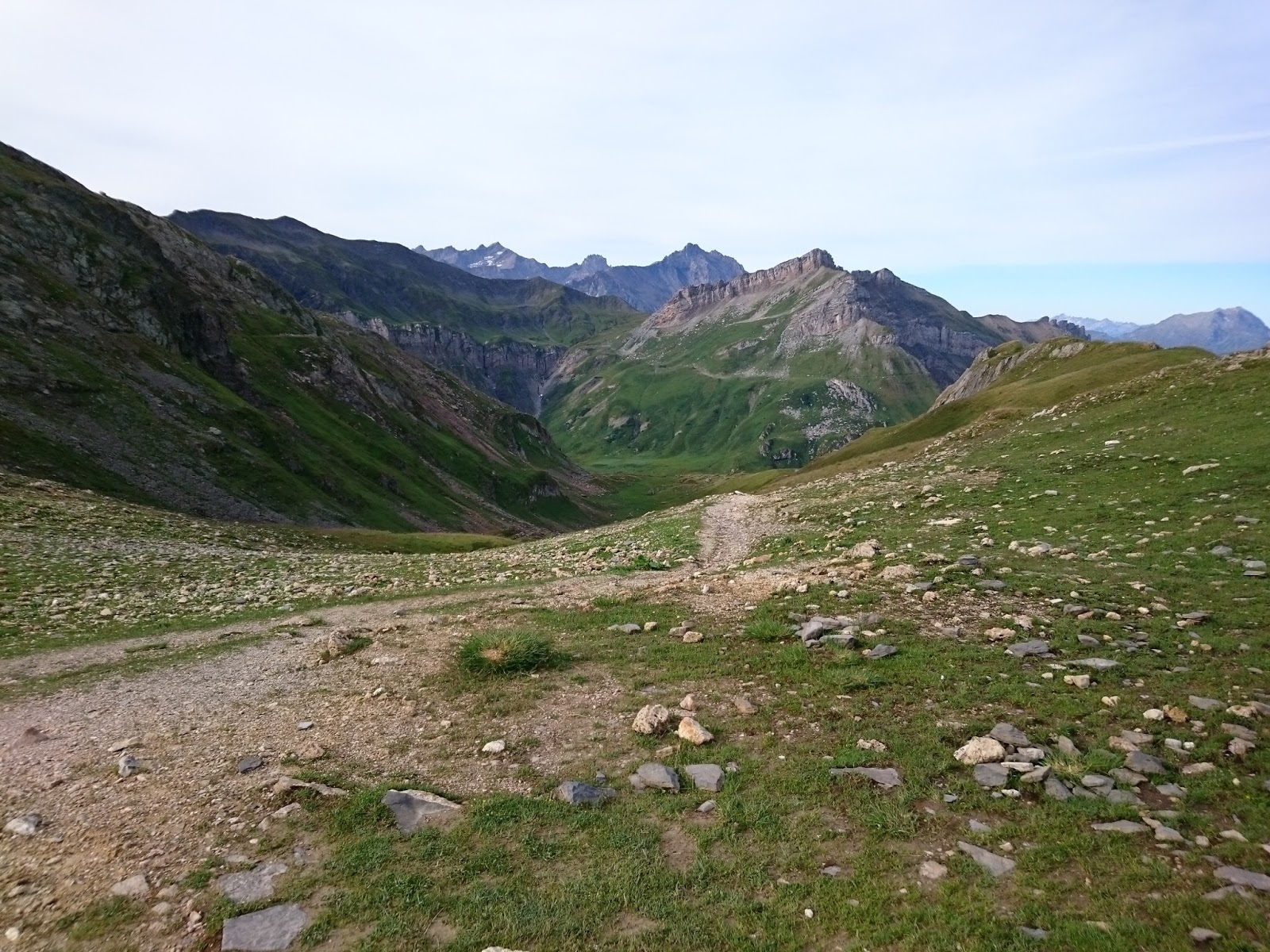
| Descent into Arnuva. Smile now, the sun is coming soon enough! |
I was now 124th overall (but didn't know). I enjoyed every minute of the traverse to Refuge Bonatti, with the sun still hidden behind the ridge to my right. There was going to be heat suffering later. At Bonatti, I had my first indication of ranking. When the volunteer scanned my bib, she said, "You are in the top 100." It seemed a little higher than I expected. Turns out, looking at the rankings later, I was 122nd. So I have no idea why she said that.
Down to Arnuva aid station (96k), I saw a volunteer I knew, whilst filling my water. I had run with him at the training camp. He told me I was 9th woman through. That was the first I'd heard at all. I had two brief thoughts. One I voiced aloud. "It's still a long way to go - anything can happen." And the silent thought was, "Oh, crap, now I have to start defending a top 10 spot!" I didn't want to get into that kind of mental place until perhaps 30k to go.
 |
| Climbing to Switzerland! Passport? Check! :) |
From Arnuva, we climbed to Grand Col Ferret, a beautifully closed in valley that ends with the col that takes us into Switzerland. Guess what? I like that climb, too :)
On the other side of the col, I tightened my laces again. I was surprised my feet weren't swelling more and I was getting a bit of toenail pain from them banging my shoes in the steeper descents. I also lathered up with sunscreen. It was 10:40am and I was well and truly into the sun. Expected high of 30 to 35 degrees. Luciana Moretti passed me - and everyone else - going down this descent like we were standing still. She was in her happy place and looked set to run through the lot of us. (She finished 6th.)
The descent to La Fouly aid station over 10k feels like forever - a joy on
fresh quads. I was starting to suffer from the heat - there were no streams in this section for soaking hats and clothes. I was playing the "I don't want to eat but I have to" game. I began mounting evidence to rationalise a DNF. It was piling up quickly. I mounted a counter-offensive in my brain, as I knew if I quit this race, I sure as heck better withdraw from the 300 mile Yukon Arctic Ultra. I made it into La Fouly thinking I'd cool down a bit and get a mental reset. Unfortunately, the chief volunteer in the aid station was working with the enemy! I pulled out my sheet with elevation profile and splits to see how long the next section was (for me) and thus how much water I needed. She rushed over to helpfully point out the bulletin board in the corner with race particulars. As far as I knew, though, that bulletin board didn't have
my splits on it. I said thanks, but that I just needed to look at my splits. She attacked again. "It's only 15km. It's not hard, it's easy."
 |
| There is no shade. Put the discomfort in a box. |
She was clearly against me. Easy? Easy is laying down. Easy is having someone rub massage oil on my back at a beach resort. Easy is
NOT running 15km of undulating sun-exposed trail at 30 degrees after 18 hours of running and a sleepless night. I made a tactical error and bit. I said, "It's not easy. It's hot."
She saw my weakness and closed in for the kill. "But you only have 61km left!" AGHHHHH! Up until then I hadn't thought about kilometres at all. I thought in terms of aid station to aid station and I counted the total number of climbs. I had 11 climbs to do and I was done 7 of them. 61 km of mountainous trails. That's FOREVER. I stammered. She smiled. "You've already done 110km!"
Wow. She was good. I've done 110km. No wonder I'm tired. And I still have 60 left. That's nearly half again what I've already done. Totally demoralising. I had to get out of there, fast!
I left La Fouly in 115th position, spotting what looked to be a girl coming in as I left. Next stop, Rolf at Champex-Lac, where I could hope to try that regrouping-resetting thing again :) I started off on the trail and thought of something a runner said to me recently. "I'm really good at putting my pain in a box," he had said. I started to recite, "Put your pain in a box." But I didn't like the negativity of "pain" (and I wasn't really in pain, as in "agony" pain), so I changed it to "Put the discomfort in a box." Every time I had a negative moment, I repeated, "Put the discomfort in a box." I wasn't even going to own it. It wasn't "my" discomfort. It was just discomfort. If I claimed ownership, it might hang around longer ;)
 |
| Champex-Lac during training camp |
At Champex-Lac Rolf was indeed ready to save the day. He'd also just saved the day for a Japanese runner, whose wife's rental car had broken down on the road climbing into town. Rolf had picked her up and taken her to the aid station - much before I arrived. That runner must have been pretty close to the front.
Rolf was in town for a while, so he had been seeing the carnage of runner after runner come in and call it quits. People were milling around the aid station looking dazed. I saw several girls. It was hard to figure out who was still in the race and who was definitely done. Some of them probably didn't know, themselves, at the time! Rolf's understanding was that I was in 9th or 10th position. I thought it was 10th, after I had been told 9th at Arnuva and Luciana had passed me. There were five girls very far ahead and then Luciana just 5 minutes up, Darcy Piceu, 20 minutes up, Steph Howe and Fernanda Maciel a little further. We swapped shirts for me, giving me a completely soaked RaceReady one. I've found nothing that beats those in extreme heat. I shuddered with cold when it hit my skin. I had to fix a hot spot under one foot. I forced some calories in, repacked, and turned to go. I spotted Steph Howe, who was supposedly 30 minutes out in front. She had apparently been coming and going at the aid station, not actually leaving. I left before her and she ended up finishing 8th. Fernanda Maciel pulled the pin there, though I didn't know it at the time. Manuela Vilaseca of Brazil came in just as I was leaving. I smiled and nodded. Her crew person noted me. The race was definitely on between us two.
I knew there was forest ahead and looked forward to that. This was also the new-old climb, where they swapped back to the old, technical, steep, overgrown trail to La Giete, rather than the easier Bovine track. But I really didn't mind, as I was just happy to be in thick forest out of the sun. And my quads didn't mind hard climbing. It was the descents I was paying for :)
I arrived in Trient (141km) three hours after leaving Champex-Lac. I got to enjoy a few minutes with Rolf as pit crew again. He later shared another of his crew stresses - navigating along narrow mountain roads, through tiny towns and crowded carparks with many drivers who were foreign to the area - and likely it was the partner out trail running who was the one with the superior spatial skills - the one who would normally be the driver in such conditions....
 |
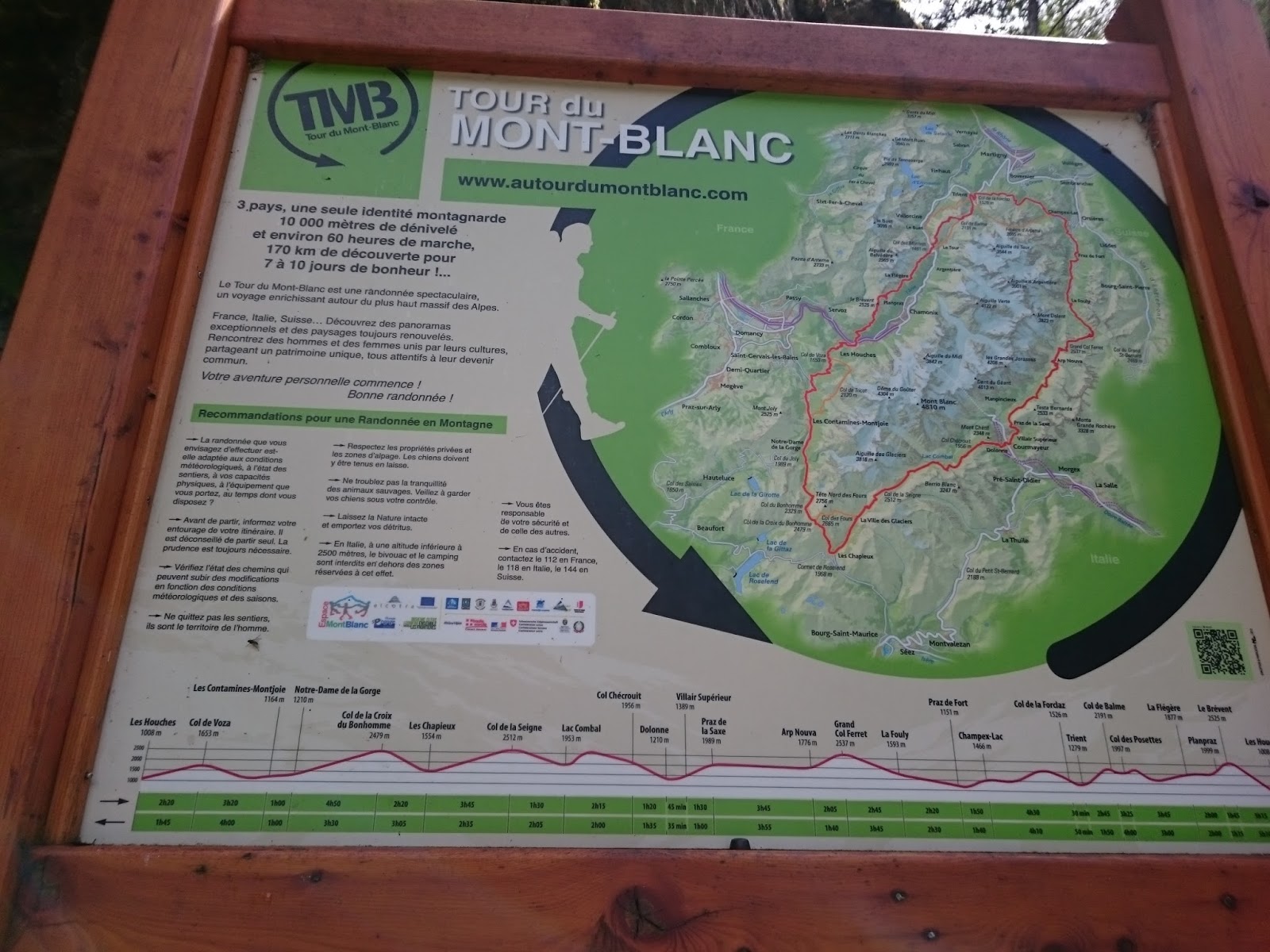
| UTMB roughly follows the TMB, roughly a 10 day hiking loop |
I refilled my pack with 2 litres, thinking it was a 3 hour section to Vallorcine (10 minute drive for Rolf!). Manuela Vilaseca came in, her assistant greeted her, and sat her down, whispering and nodding in my direction. Manuela sipped at the juice from a fruit cup, listening to her crew, as I did up my pack. I was out of there. I felt confident with my climbing but less so with the descents. I had to create distance in the climbs.
Glancing again at my splits on the trail outside of town, I saw it was only a 2hr section. I immediately set to squeezing water out of my hydration pack. Mentally as well as physically, I didn't need a full 2kg of water to hinder my progress up the next mountain. I let some drain onto my quads and shins as I climbed, to cool me. I relished each switchback, as it put me more out of view of any runners behind. Like Manuela :)
The small bit of "lead" I'd built in my splits over 24 hours was eaten up that evening by the accumulated heat fatigue. I arrived in Vallorcine (151km) basically as I'd originally predicted. This was my last crewed aid station. From here, it was 3 hours+ to the finish line over one more climb. A rocky, technical one I'd done twice before. Rolf thought I was in 8th position. I was 95th overall.
I headed out for the gentle climb to Col des Montets, where we cross the road to climb the big one - Tete aux Vents. Rolf was there. He had confirmed with the race organisers that it was okay to see me as a spectator on course and he could share info with me, but couldn't accompany me or give me food, etc. He had received an update that showed I was in 7th place. He'd seen Manuela come into Vallorcine after I left. He didn't know how long she was there, as he left to catch me at the road crossing. He'd heard there was an American girl coming who seemed to be blowing through the field. I wondered at either Steph Howe or Sally McRae and certainly thought them strong enough to put in a hard surge if they came out of whatever bad patch they had been in. I hadn't heard anything of Sally since 4am at Lac Combal.
 |
| Tete aux Vents climb w/Rolf in training. Vallorcine below. |
Time to run scared. The climb seemed to last forever. Though I'd done it twice before and loved it, this time it really did feel tough and endless, with even more hand-over-hand sections than before. Though I almost never talk to anyone when racing, preferring to stay in my own head and listen carefully to my body, I exchanged a few brief conversations with nearby blokes, all English speaking. It helped me get out of my head for a few minutes to forget about the pressure and enjoy the humanness of the journey. We all broke into our natural rhythms over time, spreading out along the hill. It felt like it must be after midnight - that the climb had been so slow I'd lost my goal of going under 30 hours on the new course. For the first time, I switched my watch to time of day. I'd only run section-by-section, from one split to the next. I actually had very little idea of time of day except by rising and setting sun. It was 10:10pm. I was convinced my Garmin was wrong. It must be later. I tried to figure out how it could be wrong, given that it reads off satellites. I saw it change to 10:11pm. There was hope not only to hold 7th place, but also for the sub-30 hour goal! I continued the traverse along the ridge top, where I felt quite confident in picking up the pace across big boulders I often find intimidating. I kept an eye out for headlamps behind and kept making myself fuel. I wasn't particularly nauseas, I just hadn't felt like eating all day in the heat, so it was a struggle.
I tagged in and out at La Flegere, the last aid station, without stopping. 93rd position. 7km downhill and 1k flat through town left. I started to push more, careful to dance on the edge of nausea without going over. The closer the finish got, the more I pushed. It's quite a zigzag through town before you get to turn the final bend and see that giant gantry. Done.
- 7th female (5th in V1 category)
- 29h 40m 11s
- 89th overall of 2,563 starters
- 1632 finishers + 931 DNFs (36%) - by comparison, last year's DNF rate was 35%
- The 46.5hr cutoff was extended to allow runners to finish for another 40 minutes, presumably because of the high heat.
I was interviewed at the finish for a few minutes, but I wasn't very nervous, as I consoled myself by thinking no one nearby would be listening, given it was late at night, surrounded by a few French, with me speaking English. I found out later from my mum that she listened to the interview live online! Yikes! Glad I didn't know :)
I was kindly taken to get my finisher's vest and then led to another tent, because I had volunteered for a research study on hyponaetremia in drink-to-thirst athletes vs drink-to-a-schedule athletes. They pricked my finger for blood and took my weight. Then I sat down to answer their questions. Slowly, the world started to go black around the edges. Saliva pooled in my mouth. "I'm sorry," I said, "I'm starting to feel like I'm going to faint." I hated to say anything, as I expected dramatic overreactions. Instead, I got nothing. She asked again for my phone number for the paperwork. I tried again. "I'm sorry. I don't feel well. I might faint." She said, "It's okay. We're almost done. I just need your phone number." I couldn't talk anymore. I couldn't make the numbers come out of my head. "Country code....6...plus 6...1.... I'm sorry, I have exercise associated hyponaetremia." Thinking in my head, that's funny - not hyponaetemia, that's what they're studying! What's the word, what's the word? Blacking out.... She says, "Would you like to write it?" I took the pen and wrote the number - it looked like I had advanced Parkinsons, it was so shaky. Then I remembered what to do - put my head on my knees... Ahhh, relief. Exercise-associated hypotension. That's it, I thought to myself. Low blood pressure caused by sitting down after 30 hours of running. Calves weren't pumping blood for me anymore. No one cared. But with the blood coming back to my brain, I remembered the words for my condition :) I sat with head between knees, alone, for several minutes before standing to go.
Well, at least they didn't get overly dramatic about it ;)
The race result seemed somehow a bit numb to me until Sunday evening at the presentations. I sat on a dirty step in a patch of shade, watching the 5 women and 10 men taking the stage. UTMB has said that from 2016, they'll recognise 10 women on stage. Regardless of my finish result, I was disappointed they didn't change their rule on that for this year. A song came on the speakers, loud enough for half the town to hear.
Feeling my way through the darkness/Guided by a beating heart
I can't tell where the journey will end/But I know where to start...
So wake me up when it's all over/When I'm wise and I'm older
All this time I was finding myself/And I didn't know I was lost.
I saw myself running through Saint Gervais. I saw the 27 hours that lie ahead of me. I cried, alone, on that step.
Gear:
UltrAspire Omega pack (8ltr)
LED Lenser SEO 7 (x2 at night)
Leki Trailsticks
Inov-8 x-talon 212s
Compressport trail shorts
Icebreaker undies
Montane Primino short-sleeve shirt (140g merino wool)
Champion sports bra (the model with no inside seam at the sternum!)
Compressport full socks with 2Toms BlisterShield and SportShield inside
Ryder sunnies
Garmin 310XT (x2)
Perth Trail Series 'tubie'
Other mandatory gear not worn: Icebreaker thermal top, Icebreaker gloves, Mammut waterproof overgloves, Montane rain jacket, Raidlight rain pants, beanie
 |
| At Col de la Seigne during camp - old route went straight down valley. Col des Pyramides Calcaires is on the left. |
 On to America in October. The Canyon de Chelly 55km Ultra on Navajo Reservation land. A celebration of Rolf's recovering knee injury - a long year with lots of low points. Elders lit a fire and said prayers to greet the rising sun in the east, blessed us with eagle feathers, then sent us running towards the sun, down a canyon full of ancient ruins and petroglyphs. A handmade turquoise necklace was placed around my neck at the finish. I was thankfully too tired to attend to any rumble of discontent in my head that night.