"The goal is to become the unique, awesome, never to be repeated human being that we were called to be." -Patricia Deegan

Saturday, February 21, 2015

All the Advice You'll Ever Need

Now that I've got your attention.

I'll admit that this probably isn't all the advice you'll ever need. But it's most of it :)

Over the past couple years, I've been receiving increasing numbers of emails from runners far and wide, some I've never even met, asking me for training and race preparation advice as they embark on a journey towards an ultramarathon. I finally thought it's time to try to summarise what I think are the gems I've learned over the years. Hopefully you, the reader, will find at least one pearl of help in here for yourself.

How many miles should I run per week? 

Don't neglect the power of resting on the sofa sometimes!
Sure, I could just say "It depends." On your prior history of running, injury history, experience, current fitness, time commitments, stress levels....but let's keep it simple. The take home message is "Run as many miles as your body says you can without breaking." BEWARE THE ONLINE TRAINING PROGRAM. I bounced off injuries for a couple years trying to run 100km/weeks and back-to-back long runs on weekends when my body clearly hadn't made the necessary musculoskeletal adaptations to tolerate it. I won the 6 Inch Trail Marathon some years ago on a max week of 85km. And I didn't sit at that week after week, either. The first time I ran that race, in 2008, I did it on 65km weeks, as that's what I could fit in my schedule and run without breaking. By 2010, I was able to do ONE peak week of 100km building to races such as the Sri Chinmoy 24hr (200.886km run) and the Moe 6hr (70.4km run).

How long should my longest run be? Should I do/change/increase speedwork?

The adage of Easy-Hard is often applied to weekly training. Run easy one day, then do speedwork (very roughly, we could lump them all: tempo, interval, fartlek) the next. The Easy-Hard principle makes good sense. I think it can also be applied to back-to-back long runs, too. Just because a 5 hour run is done at an easy pace does not mean it's an easy run. It needs to be put in context. If you run 4 hour runs all the time, maybe it is indeed easy. And if the day before and day after you run 10 or 15km (or not at all), maybe it is indeed easy. But if you run a 4 hour run and then wake up the next day to run another 4 hour run, can that second run REALLY be called easy? Only if it really feels bloody easy to you - and not to anyone else or any program's advice. That second run might really be a hard run.
Barefoot beach running. One man's easy, another man's hard.

But I heard one should learn to run on tired legs!

I can't swallow this logic. Should I eat 2 greasy burgers and some hot chips before a 5k race, so that I can learn to run with nausea? (Because I surely might have nausea during my ultra.) Should I run with knee pain in training, as I might get knee pain during an ultra?

Tired legs equals bad form. If I've got no glutes left, my adductors and other smaller muscles, tendons, and ligaments are going to have to start doing more work than they are meant to. That is an injury in the making.

I think this statement could be useful to the development of a mind state - to toughening up the mind to run with a tired body. Well, if you need to toughen up your mind, I'm sure we can come up with options that don't require a leg injury to get you there! How about running early in the morning on a cold rainy day? Or late afternoon on a hot, humid day after work? That will develop mental toughness! :)

Perhaps a person could practice somewhat to run on "tired legs," but should probably do said run alone, so that you can really be aware of your running form and keep consciously reminding yourself (hips forward, activate the glutes, don't slouch, pick up your feet).

Should I run 7 days/week? Should I have 1 rest day? Can I run an ultra if I can only run 4 times per week?

I recently heard a saying, though can't find the original source to attribute it: "Optimal stress plus optimal rest equals optimal progress." This is somewhat akin to the easy-hard principle. If the idea of "rest" sounds like "slacker" and puts your brain into meltdown, change the term. Call it a "recovery day" or a "consolidation week." This is when your gains are made, when muscle fibres knit themselves back together stronger and fresh oxygenated blood comes into your ligaments and tendons.
Track kms, including elevation if you're doing hilly stuff. Hills add to load.

So it's never possible to say everyone should run 6 days per week or that 4 days per week is enough. It's relative to your individual body and to your individual lifestyle. Back in 2009, I was often running just three times per week. More running means more maintenance. Once you up the running mileage, you'd better add in 10% of that additional running time for icing, rolling, massage, and stretching! (As well as extra showers and laundry loads!)

For an ultramarathoner, I think the essential base comes from two key sessions. One long run on the weekend and one mid-week 1.5 hour easy paced, preferably hilly (trail) run. Get those done. And build sessions into the week around those, using all the tips above, including the "easy-hard" principle.

Can I backup one race with another very quickly? There's "This Other 50/100km Race" just two weeks after "That Special 50/100km Race"....

Greedy, greedy, aren't we at times? :)

In most cases, the answer is no. What if it's three weeks between events? Usually, no. Unless your body is really well adapted to racing ultra distances, you will not have recovered in time. You might feel great for 20k, but then almost surely the wheels are going to fall off magnificently.

If your body is adapted to ultras, if you track your resting heart rate and can see it's come back down to its low normal, and probably if you didn't race the first race in an all-out best effort, you might be able to "capitalise" on your fitness and get another race in so close. But if you ran your best effort in race #1, don't expect that your endocrine system and tendons have finished their internal mop up job, just because you think you "feel fine" running an easy 15k around the local lake.

How should I pace myself for this ultra I'm doing?
Don't take too much from the token jar at once!

I read a great tip from a 10k to half marathon runner in R4YL magazine a couple years ago (can't remember who it was, unfortunately). She said that at the half way point, she should not yet be struggling or feeling it's too hard, or she's in big trouble. An ultra is quite similar. You shouldn't be going so fast that when you reach halfway, you're already in Hurtsville. Conversation pace. You should be able to sing the national anthem easily in the first third of the event (if you know your national anthem, that is!) Your pace will slow, that's inevitable, so don't think to try to keep it even. But similarly, don't think you can "bank" time for later. The faster you remove your "tokens" from the "energy" jar in the first part of the race, the fewer tokens you have left at the end. Expect a hard physical start to equate to a hard mental - and slow physical - finish. More even splits are proven winners.

When should I do my longest run for this ultra?

Five weeks out is pretty standard. Go further out - closer to eight weeks, if you feel you're pushing your boundaries and/or are prone to injury. This will give you a good couple weeks to rest any niggles without feeling the pressure of the race looming.

How do I prevent injury?
Food to refill muscle glycogen after a night run - setting up for the next run

Other than adhering to the above related to taking recovery days, doing mileage your body can cope with, and such, I attribute my injury-free state the past three years (no injury since Nov 2011 compartment syndrome during the Bibbulmun FKT) to: (1) healthy diet, including anti-oxidants (just think fresh fruit and veg, lots of colours - that keeps it simple) and daily anti-inflammatories (e.g., avocado, Udo's Oil, chia, and salmon if you're a fish-eater) (2) weekly massage (twice weekly if things are getting out of hand), (3) ice baths (optimal temp about 13 degrees, not freezing) and ice cup massage on lower legs/shins (technique described elsewhere in my blog), (4) strength work (e.g., core work, glute strength exercises), (5) biweekly (or more) sports chiropractic (this is more than just "cracking your back" in case you've never been), (6) planned rest/recovery months into each year (I usually plan two).

Monday, January 26, 2015

Australia Day Ultra 100k

Diary of an Ultrarunner:

Late December: 

Early Jan: 3 day/120k trail running block about to begin
I hear about new 50/100km road races to be held in WA over Australia Day weekend. It's hot. It's summer. Glad to hear there's a new event and I know the RD should put on a great one, but it's hot. It's summer. I get back to my base training for the World 24hr in April.

January 1st:

Email super nice RD. Sooooo, that new road event of yours - is it officially certified for distance so performances could go in annual rankings? It might be good for my 24hr training to have a hard hit-out at something. I'd at least like to know it would be an official distance.

January 8th:

Enter 100k race. Quickly rewrite program to drop miles and add a few speedwork sessions. A few will have to do. The race is in 2 weeks.

January 11th:

Continue to harass super nice RD, now telling him that though it's hot, it's summer, and I'm not in peak fitness (I've been running base with 150-200km weeks), I might just possibly be able to break my own AUS and CAN W45 100km records of 8.47.54 if the weather is kind.

First speed session in 7 months. 5k race in 30 degrees. This will at least give me a benchmark as to where I'm at. Perimenopause was anointed upon on me about 6 months ago (looking back with hindsight) as I had suddenly put on 2kg (which had me and my strength trainer very confused) and I developed hot flashes soon after that (attributed at first to international flights and adjusting to summer in Europe). 5k race result suggested I was just as fast as last year. (Hmmm, what if I could drop those bloody 2kg??)

January 13th:

Track. Oh, the horrors.
Two days after 5k race. Track session with Masters Athletics in the heat. OMG the pain. But further proof that the speed is still there. I have data to create a pace plan now. Said plan will factor in for the heat, estimating at least a 15 minute loss. More if it goes above 27 degrees.

January 21st:

Last hope of the RD ever liking me as a person again, as I send him yet another email asking if there might be a marking/tape out on race day to record my 6 hour split, as I should break the CAN W45 record. (I'm not even telling you about my other emails to him!)

Beetroot loading. Hammer Race Caps Supreme experiment continues.

January 24th:

Wake up at 2am. It's race time! To mitigate the heat, the events started at 3am.

For the next six hours, I ran to my calculated splits. People passed me and I passed them back. I just kept running to my splits. This method is tried and trusted for me. It keeps me from getting emotive, from chasing people or feeling hunted. I just repeated my mantra, "Run to the maths." Hammer Perpetuem in 250ml of water, carried in a handheld, swapped every 31 minutes or so when I saw my crew, Rolf, as I traversed the length of the 6.25km course. I tried to enjoy the very pretty course, run alongside an estuary with shorebirds, roos, and people out wading with their fishing nets.
Approaching my crew, midpoint on the 6.25k course. Perp and pear, please!

Given the early start, conditions were good for the first 5 hours, as expected. Starting temperature was around 14 degrees. But once the sun peeked out over the scarp about 6 am, the temperature slowly rose. Heat management started about 8.30am, with the first water being thrown over my head. From then on, the aid stations got to know me by my call of "Two water!" as I ran by. I would dump most of both over quads, hammies, calves, chest, and/or back, depending on what needed it most at the time. The last bits of water in the cups I'd swig.

As the temperature rose, so did the wind. Whilst this helped with evaporative cooling, it required greater push for the southbound leg of the course (6.25k north, spin around, come back south 6.25k. Repeat 8 times.) I had calculated splits to account for temperature as best I could, but forgot to add wind (I had meant to). One online calculator using Jack Daniels' formula suggested that a 20kph headwind might cost me about 11-12% in VO2 demand. The tailwind going north would only give me a 7-8% gain. Thus, once the wind picked up, I was losing a net 4% in having to work harder to keep the pace.

Well, I guess that science stuff is pretty darn good. Because I wrote a plan for 8hr 29 min and ran 8hr 32 min, falling off the pace after the 6 hour mark. So, 2.5 hours in 20kph wind, resulting in a 4% loss would roughly mean 6 minutes lost.
The 24hr shoes are now the 100k shoes, as well.

My A goal was to have a good, hard hit-out at something before World 24hr. I met that goal. The B goal was to break my W45 national records. Met. The C goal - the goal that if everything went perfectly, weather, my running form, crewing, etc - was to meet the Category A qualifier level for both international and Australian standards for 100k. That's 8hr30 for a woman and 7hr flat for a man.

I only missed it by 2 minutes. The writing was on the wall by the end of lap 7, the 87.5k mark. The wall was sealed with lacquer at the 93.75k turnaround. I looked at my watch (knowing what I was about to see) and had a good chuckle to myself. I had to do 6.25k at a sub 5 min/k pace. Wasn't going to happen! The slacker on my right shoulder whispered in my ear, "It doesn't matter now. You might as well take it easy. You're leading anyway." The pusher on my left shoulder slapped slacker upside the head and said, "You need to cross that finish line knowing you gave it your best, no matter what the conditions were. You need to finish at peace with yourself and the course." Thus it was that my next couple km were over 5.30 pace, as slacker and pusher tousled, me running into that bloody headwind. Finally, slacker fell off with a thud on the pavement. I then ran a 5.11min/k, a 5.00, and a 4.55, finishing the last couple hundred metres into the finish at a sub 4 min pace. I knew all along I'd miss 8hr30, but I finished able to say I'd done my best on the day.

As a bonus, first outright at the first event!

Saturday, January 10, 2015

Looking for The One Percenters

World 24 Hour Championships, Torino, Italy, 11-12 April 2015.


It's been haunting me. Ask any of my running mates. A couple months ago, I had to commit to apply. I did. I was accepted. But I wasn't jubilant. I felt not just ambivalence towards the race, but almost resentment towards it. Where was the mojo?

I've been running. Trail running, road running. All good. Enjoying the miles, solo or with mates. This wasn't burnout. I was happily training...but for what? If I didn't want to do World 24 Hour, what did I want to do? I had a long list of maybes.

Yet I wasn't eager to sign up for anything. Everything was rejected for some reason or other. I wondered if maybe I was just done racing. Maybe my competitive gene had fizzled out.

After two months of talking about the "problem" (alternated with ignoring it or "being" with it), of looking for answers in ultra running podcasts, of listening to mates' stories of their own racing goals, of talking more, of more quiet reflection, I finally found what I think is my stumbling block.

My running story told in triangles
Over the past 7 years, I've learned a lot about running and performance-related things. I've learned about bad fat in processed food. About glycemic index and insulin spikes. About foam rolling, sports massage, ice cup massage, and needling. I've learned about good fats, turmeric, epicatechins, antioxidants and anti-inflammatories (the natural ones). I've experienced musculoskeletal adaptation that allows me to run double the mileage I did 7 years ago. I've learned about speed work, track sessions, Mona fartleks, Masters Athletics, beetroot juice, and caffeine. About form and gait when running, low heel-drop shoes, eccentric calf raises, neutral shoes. How to eat right after a long run, how much glycogen is stored in muscles, and what tends to cause (and how to prevent) blisters. Studied hypobaric vs hypoxic training, heat acclimation vs acclimatisation. Calculated pacing programs and compared the effects of positive, negative, and even splits in racing tactics. Had DEXA scans, electrical impedence scans, ultrasound scans, CT scans, MRIs, and VO2max testing. And that is certainly not a comprehensive list!

Accompanying all this, my running performance has seen gains that look a lot like that little chart above. Now, I'm sitting at that last triangle on the right. What's next? Where do I squeeze out more performance now? Stop working? Become a full-time athlete? Move to a mountaintop? (with a training field in the valley below 1500m, of course.)

I've been wringing out a towel of goodness for 7 years. But you know what happens when you get that towel nearly wrung out. Getting those last few droplets out is HARD. Your hands burn, your fingers get red. You work for those last few drops. Yes, you worked before, but it's nothing compared to the work of getting the last drops out.

That is where I think I'm at.

Am I ready for the mental AND physical challenge ahead? The challenge of trying to eek out a few more drops?

I've decided it's time to try. So with that in mind, I've researched a few things that have been on my "someday" list for a while. Things that may be "One Percenters." There are several more to research, but here are a few:

With a mate on a 3 day training weekend
Coenzyme Q10. (CoQ10). This substance is made in our bodies. It's also found in oily fish, nut oils, avocado, and organ meats. Cells use it to produce energy. Although our bodies make it, levels do decrease with age. Intensive training decreases it, too. So, a supplement sounds like a good thing - ensure levels are up so that our little cell powerhouses are fully powered. Unfortunately, the jury is out on whether supplementing actually can improve performance. There are so many ways to research a supplement that it can be hard to interpret and compare results - you can vary dosages, test different types of people (e.g., sedentary old men, recreational runners, elite bodybuilders), have one group on a placebo without knowing it's a fake pill, limit the use of other supplements like vitamin C by participants.... The body is very good at keeping itself in homoeostasis. So unless there's a great deficiency, a CoQ10 pill might just all be pee'd down the drain. Healthy runners rarely have vitamin deficiencies. BUT, there is a small amount of evidence supporting supplementation (maybe at 200-300mg). It's generally well tolerated as a supplement, with no ill effects. So, given that I tick the boxes of aging and intensity in training, and the fact that I've already capitalised on the "big ticket" performance enhancers (e.g., weight loss, low GI diet, speed work), I'm going to give it a go. My choice is to try the Hammer Nutrition Race Caps Supreme for a minimum of 6 weeks. I'm keeping in mind Race Caps also have magnesium and vitamin E/tocopherols. Magnesium I discuss below, but not vitamin E. For the sake of keeping this blog post manageable for me to write and you to read, let's just say there is some support for the antioxidant/vitamin E. It's on the AIS Group B list and discussed here more.
Natural strength training opportunities on a 70k run!

Magnesium (Mg). A mineral used for all kinds of chemical reactions in the body. Some is stored in bones and is used for bone maintenance and growth. It's also used by nerves and muscles and neutralises stomach acid (hence its use in antacids). Mg is in all sorts of foods, but particularly in high fibre foods like whole grains, seeds, nuts, legumes, and green leafy veg. People living in areas with naturally occurring "hard" water get more through their water. Why am I interested in Mg? Because of the periodic sleep deprivation I get due to "restless legs." It's been touted as a fix for muscle cramps (though my restless legs aren't a stereotypical painful cramping). Research says Mg levels are tightly controlled by the body. Although levels in blood increase right after high intensity exercise (likely due to muscle breakdown that causes it to transfer from muscle into the extracellular fluid - just like happens with potassium), levels normalise within a day. In prolonged exercise, one might think levels could go down, as the broken down Mg is pee'd and sweated out, but it doesn't seem to be the case - and again, levels normalise within a day. Taking oral Mg and expecting a change in internal chemistry looks to be a tough one - the body keeps its levels under control. So, unless you have a deficiency, you're just going to pee it out. Knowing whether you're getting your RDI appears prudent with this one. There's a small amount in my Hammer Race Caps, so I'll consider that a potential top-up and leave it at that. Though doing a food diary and adding up my daily Mg intake would be the scientific thing to do. That's one of those "when I have more time" projects :)
Even loving it at 30+ degrees! (Mind games are key)

Pineapple. Just the other day, someone told me they'd heard pineapple was an anti-inflammatory. I'd never heard that - and I think I do a lot of reading. Well, that very night, I picked up an article that said "eat pineapple for the anti-inflammatory properties." Okay, time to research. Pineapple is a "bromeliad" flowering fruit. There's an enzyme called bromelain in it. Well, I think bromelain is more technically a mix of protein-digesting enzymes (yes, enzymes that digest protein, which is possibly the reason it "tickles" or stings the mouths of people who eat a lot - your mouth has protein in it, after all.) Bromelain is a natural blood thinner and anti-inflammatory. It really has been used as such by the medical community. Bromelain is extracted from the stem and the juice of the pineapple. The problem is that it does not occur in high enough doses naturally in the fruit to act as medicine. Stick to the omega fats like Udo's Oil, walnuts, and avocado and turmeric (curcumin) for your natural anti-inflammatories. But feel free to enjoy a pineapple for its anti-oxidant/vitamin C :)

A 60k day on the Bibbulmun Track
L-carnitine. The Australian Institute of Sport (AIS) currently lists carnitine on its Group B list of supplements. It's their official list of "maybe" performance-enhancers. The "jury-is-out" supplements, according to their review of the research. L-carnitine acts as an antioxidant not unlike CoQ10 (to my untrained eye). It helps the body breakdown fat to convert it to energy and it's made in our bodies. It appears helpful for people with certain heart conditions like angina. It occurs naturally in many foods including dairy and avocados, but is definitely highest in red meat (hence the "carni" in the name). Research is definitely scant, but supplements are well-tolerated. So, I might just start dipping into that bottle I've had laying around unopened for 6 months. Another experiment in One Percenters :)

Well, my hands are sore. From researching and blogging or towel wringing? Time for a little speedwork. I've got a 100k in two weeks - decided to put a training race into the program a few days ago. I won't be in peak shape for it, but that's what training is about, isn't it? Getting into peak shape :)

Sunday, December 14, 2014

Dear India, Thanks for the Uncertainty

Trying to weave a coherent, sequential story out of my 2 weeks in India is like trying to drive a car whilst focused only on the side view mirror. When you're driving, you're in a highly spatial state, doing many things seemingly at once - braking, checking mirrors, talking, listening to the radio, steering.... Similarly, India happens spatially. And if you try to force sequencing on it, well, it's just that. Forced. The result will be some sort of discomfort, if not downright angst or grumpiness. India plays with all things sequential, serial, linear, and ordered like a cat plays with a grasshopper.

So with that in mind, here is my non-sequential story of my 2 week visit to Arunachal Pradesh, a state in remote north-east India, bordering Bhutan, Tibet, and Burma.
The course along the Siang River (called Brahmaputra river further south)

Organic and sustainable. The jungle is alive. And far more than with mosquitoes, leeches, and biting flies, it is alive with wild guava, mandarin oranges, bananas, and other manner of organic jungle food I've no English names for. Seeds are harvested and planted and the cyclical nature of Earth's seasons is at the forefront.

Hanging bridges. An excitement for foreigners, a routine lifeline for villagers.

Borders are for governments. In the furthest north, the currency was still rupee - if I could find a place to spend some - but the Tibetan greetings of Tashi Deleg were common.

Plastic has no place. In the jungle, everything is made naturally. The cups are bamboo, plates are banana leaves, cutlery is fingers. Take away? No problem, banana leaves fold up perfectly into "sandwich bags." Baskets, chairs, fences, gates, and ladders are made of woven, interlaced, and fitted straw and bamboo. When I wanted a "foam roller," one was fashioned out of a large, smooth piece of bamboo in minutes. One becomes acutely aware of any plastic wrappings in a place like this. The one thing these people have never had to create in the past is a rubbish bin.
Being served lunch in a home after day 1

Calcutta is not India. Nor is Mumbai or Trivandrum or Dharamsala or Arunachal Pradesh. India is vast and varied.

India is spiritual. You're as likely to be asked your religion as how many children you have. It's the kind of place where your Muslim driver joins you and your Indo-Tibetan Buddhist guide on a 3-day Buddhist trekking pilgrimage. Where you could utter a prayer at a meal to Ganesh, Allah, Jesus, or the Flying Spaghetti Monster, or recite a Buddhist mantra, and no one would bat an eye. Where you can hold a ceremony to put up Tibetan prayer flags and a Hindu family helps.

Tea. I've had the best cups of tea of my life - and some surprising ones - on this trip (Ginger tea is made with milk??) I also came to learn that tea is a luxury in the jungle. You don't gulp it out of giant mugs, looking for the caffeine hit, but savour it like a piece of dark chocolate for dessert.

Everyone's getting along now, but come night time it can get noisy!
Rice. There are more flavours to "plain white" rice and more ways to cook it than I knew. And there are people who never tire in their whole lives of having rice at every meal - breakfast, lunch, and dinner. Offer them a roti or chapati for a change and they'll turn for the rice.

10,000 hours. The adage is that it takes 10,000 hours of practice to become an expert at something. The 21 (mostly college-age local) men who ran the inaugural 3 day 100 km Run Siang trail race had never trail raced in their lives. They weren't "trail runners." One guy had done a 100 metre race once. But these guys have spent their childhoods navigating the trails than link villages - full of rocks, roots, water, vines, and slippery bamboo bridges. Often barefoot or in flip flops. I reckon several could run technical downhills with some of the world elites. They just need some time to develop endurance for distance and climbing.
They're slippery, especially before morning sun gets to them.

Normal is relative. Day 1 driving on jungle roads, I sat in stunned silence. A single "lane" dirt/mud/water track weaving alongside 70 degree steep cliffs hour after hour. Landslides periodically reclaim the road, causing waits whist heavy machinery digs out a new track. I am unnerved with the knowledge that I have to return via this road (there is only one) in some days' time. But when "some day" comes, I find I have developed a new sense of normal. The track's not so bad. And yes, the cliffs are still at 70 degrees, bridge remains are visible over cliffside, and the heavy machinery is still digging out landslides.
Just waiting for a road to be built.

Trail running fosters community. I've seen it in Perth - trail running creates community. And it was no different in Arunachal Pradesh. These people have never heard of trail running. They've never heard of Killian Jornet, Compressport, or Hammer gels. They've never heard of trail marking or drop bags or aid stations or set courses. There are no radios, no internet, no magazines, and no TVs. Yet given the concepts, they created it - the first trail race in NE India, if not in all of India. Villagers manned tables filled with cooked sweet potato, bananas and oranges from the jungle, sugar cane, and their own local version of something similar to a rice krispie square. They opened their homes to us at night so we could sleep in front of their fires. The same fires they'd wake to stoke at 4.30 am, warming tea and race cakes in banana leaf, so that we could head out to run another 5, 6, or 7 hours over hanging bridges and through jungle, bamboo forest, and rice paddies to where we'd be welcomed by another village for the night. Surely, it was a steep learning curve - like when it had to be explained twice that if you lose the course markings, you have to backtrack and can't simply take any trail you know to the village! :)
Aid station, Sissen village. You won't leave without a sweet potato ;)

Sugar cane, rice and sesame balls, oranges, and ricecake wrapped in banana leaf

Eckhart Tolle wrote "If uncertainty is unacceptable to you, it turns into fear. If it is perfectly acceptable, it turns into increased aliveness, alertness, and creativity."

If uncertainty is acceptable to you, India awaits. Run Siang!

Saturday, November 22, 2014

Run Siang

In eight minutes I'm out the door.

It's a 3 day 100km running event in remote north-eastern India. The communities along the Siang River in Arunachal Pradesh wish to raise awareness for their area, in order to help preserve it with community-based development that will allow the people to hold onto their culture and heritage.

I'm thrilled to have been invited and to go back to India for the first time in 15 years.

Siang River 100km Trail Run
24 November - 1 December

Hopefully the result of this initiative will see the event staged as an annual race from next year!

With support from and to:

Future Generations- teaches and enables a process for equitable community change that integrates environmental conservation with development. Future Generations believes that community-based change is a proven alternative path to international development.

Donyi-Polo Mission- provides educational and vocational rehabilitation to the poor and disabled children of Arunachal Pradesh so that the less privileged section of the society may come into the mainstream and lead healthy and productive lives.

Siang Peoples Forum-represent the indigenous people of Siang Belt in Arunachal Pradesh and protect the proprietary right over their land, water and air. At present, the forum is spearheading the public movement against the Govt. of Arunachal Pradesh policy to outlet all water resources to private hydro-power developers.

KickStart Property Solutions

Monday, November 10, 2014

The Bibbulmun Recce Lessons

At the end of October, I managed to wring some free time out of Google calendar. The plan was to do a three day fast-packing recce trip on the Bibbulmun Track.

To recce what? Well, I've had it in my head to try to break the fastest known time (FKT) for the self-supported end-to-end of the 1,000km trail here in Western Australia. Many people know that 3 years ago I broke the "supported" (and overall, as one might expect) record, travelling the distance in 15 days 9 hours+ with my partner as crew. My original plan had been to run self-supported. I like being on my own. It's actually easier on my brain most of the time to be alone. But supported was the way that one played out and I'm glad.
How else to cut weight? I can half that towel. Sleep bag liner was surplus.

Thus, the self-supported FKT has been in my head for a long, long time. The overall self-supported record (and still female record) was Nicki Rehn's 19.5 days, from 2009. However, in November 2012, strong, wise, and experienced ultra runner Andy Hewat from eastern Australia brought that benchmark down to 17 days 9 hours and change. That's what I have to surpass now. Basically, the idea with a self-supported FKT is no crew. You can buy supplies in towns, leave food drops in towns, but can't have anyone specifically out there to meet and help you along the way. There's no cosy bed at night, no one to cook meals or help refill a pack. Pack weight goes up from 1-2kg to about 10kg. You're wearing the same clothes for 2 weeks.

I was hoping a couple months ago to have a go at the FKT right now. But by the time I clicked on Google calendar to block out 20-some days (including lead time and recovery time), I was too late. My diary was too booked up. But after doing my recce, I can only say "Thank goodness!" There's no way I would have succeeded without spending some more time doing recce work.

Here's what I learned.

Day 1. Lesson 1. Your head must be in it. Even in a recce.

My brain was loaded down with work and I wasn't in the best of moods. I asked my partner to drop me on Albany Hwy, about 45 minutes south of home. My plan was to run south towards Collie. 40 minutes into the trip, I realised we're on a totally different highway, headed SW, not SE. The 45 minute drive became 2.5 hours. I decided to get dropped off at Harris Dam, north of Collie, and run north instead. As a result of this stuff up, I lost nearly 2 hours of planned running for the day (based on time of darkness/nightfall).

Arrival night 1 - shelter to myself!
I started running and within minutes felt water dripping onto my calves. I hadn't used this pack in a while and had forgotten the right way to seal the bladder. Fortunately I didn't soak the sleeping bag and other gear.

At 3.5km, I reached the first shelter. Looking down, I saw I hadn't yet turned on my Garmin. Nice. Get your head in the game, girl!

Day 1. Lesson 2. All zips to the side.

At dusk, with about 4k to go, I noticed it was awfully noisy behind me. Ignoring it didn't change things. I finally looked back to see my pack had come open and my drybag of clothes was dangling out, banging with each step. The pressure of a full pack, combined with having the zips meeting at the top centre, caused them to come open. All zips were duly noted from then on to be zipped to one side, not the centre.

Day 1. Lesson 3. Keep in touch with the map.

It got dark before camp. That much I was expecting. But the maps don't always match the distances exactly (small realignments over the years) and a Garmin 310 on a windy route isn't going to give an exact distance, either. I started to second-guess whether I could have missed the turn to the shelter. Getting out my map, I had to try to figure out my position in the dark. I had to use bearing (per my gps) and terrain (topo lines on the map) to sort out where I was. It was a little stressful. Would have been better to stay in touch with the map at regular intervals. There were so many intersecting bush tracks in there that I couldn't reliably say, "Oh, I'm just after this or that intersection."

Day 1. Lesson 4. Wash. No matter how tired you are.

Camp set up in the shelter and feet elevated.
I snugged into my awesome new Sea to Summit Spark Sp II sleeping bag (best buy in a sleeping bag ever!) that I picked up from Mainpeak in Perth. The bag lay upon a Thermarest NeoAir with silver foil top. This was the lightest yet most effective system I've ever had for sleeping in the outdoors. To top it off, I had the Sea to Summit Nano mossie net to shield me from all the nasties. Mostly, it's ticks I have to beware of. But spiders, red ants, scorpions, flies, and other little Aussie creatures can ruin a party, too.

I laid down without washing all the sweat, dirt, sunscreen, and 80% deet off my body. And then I spent the rest of the night sticking to myself, wishing I could crawl out of my own skin, but being too incoherent to wake up properly and go wash.

It was a day for lessons. Good thing it wasn't the real thing.

Day 2. Lesson 1. The Bibb is hard.

I didn't sleep much on night 1 because the rain on the tin roof was so loud. I fell asleep close to dawn, but was still back in my sweaty wet clothes and on the trail by 6.45 am. 12 hours and 58km later, I had done a "triple hut" day and arrived before dark. My back and shoulders were aching. My feet were aching. My hip flexors were so stiff I was walking like John Wayne in a cowboy movie. I had fought the voice in my head all day. "This is so hard. Why are you doing this? Are you prepared to do this for SEVENTEEN days?"

Good Morning, Puffy Face!
At bedtime, I couldn't sleep for the restless and very uncomfortable feeling in my legs. It was a problem in 2011, too. It's a problem after every race, but it doesn't matter to be sleepless for one night. Unless you have to get up and race again. And again. I remembered that cruel feeling from 2011 where I would lay down to rest and my legs would go into restless mode, preventing any sleep at all.

Day 2. Lesson 2. Fat sucks. 

Going so "slowly" by running standards (9min/k+ on flat), with over 10kg on my back (6kg gear, 2kg food, 2+kg water), I figured I could digest quite a bit of fat as fuel. And energy-dense fuels take up less space in the pack. Given I was carrying food for 3 days, the idea made sense. But after Day 1, I never wanted to see cacao again. I couldn't eat any nuts allocated to day 2 until evening. If it means more food drops during the FKT, that's what I'll have to do in order to fuel with more carbs than fat. Me, fat, and running just don't agree.

Day 2. Lesson 3. The end of October is too hot for an FKT.

Night 2. Not keen to bunk with giggly teens in shelter, I rig this up!
Though the days are quite variable and there can be downright cold nights (7-9 degrees) into November, there is too much chance for hot days to do an FKT this late in the year. Day 2 was tough for heat. I was developing a heat rash around my hips. November has historically been peak FKT month and it offers more daylight, but I think I'm better off to swap daylight hours for daytime cool. My sleeping bag and Thermarest combo should provide warmth at night. The early morning starts will be harsh...especially that moment when I have to climb out of the bag and put my wet, sweaty running gear back on again.

Day 2. Lesson 4. Cold peach tea is nice.

I needed a luxury item for night time. Something that would feel a bit rewarding at the end of a long day. But something that also weighed next to nothing. After drinking water all day, I thought I might not be so interested in more plain water at night. And I'm not carrying a stove for hot chocolate. So, peach herbal tea bags were in my food kit and they steeped just fine in Bibb tank water. I could "relax with my cuppa" before bed. Mind games! :)

Day 3. Lesson 1. Superfeet give me super blisters.

I know many multi-day runners who swear by the Superfeet insoles. I wasn't sold on the idea - they have a hard plastic bit under the heel and raise the heel correspondingly. I'm a fairly minimal type runner. The insoles' main aim is supposed to be to support the midfoot/arch. But after two days, my heels were sore and on both nights I had to drain and tape blisters on the medial side of both heels. Day 3 I put the normal Inov-8 insoles back in the shoes and it was lovely. Fortunately, Superfeet back up their product with a guarantee and I should be able to ask for a refund. They're not for me, but I appreciated getting to try them out.

Day 3. Lesson 2. The Bibb is beautiful.

Chew on the logic of this one for a few hours!
And it's much easier to see this at a gentle pace.

I realised that I was running north into a "commitment zone". A commitment zone is my term for a long section of the Bibbulmun with no outside vehicle access. This zone is about 60k long and it was 20k in front of me. To do it would mean I'd run another full 60k day on Day 3 into the zone and still have 20k on Day 4 to get out the other side. Adding the extra time to the outing was going to put a lot of work/life pressure on me. I made the call to stop before the zone. That meant a very short Day 3. Thus, I maximized it by slowing down and "zenning out" a bit. At a relaxed pace, I found it easier to pay more attention to and enjoy the curves of the hills and trails. I took photos of flowers. (There won't be a camera on the FKT.) I smiled and took big breaths of clean air.

When I ran the Bibb in 2011, I said near the end, "The Bibb teaches acceptance." Of all the lessons out there, this is still its most powerful.

Will I go through with the FKT attempt? I still ask myself that!

Gear included:
SPOT Tracker
Ultimate Direction Bandita 20ltr pack
Leki Cressida poles
Sea to Summit Spark SpII sleeping bag
Thermarest NeoAir pad
Sea to Summit Nano mosquito net
Steripen
Garmin 310XT (two) - not workable for two weeks though
Icebreaker Aero 120 t-shirt (x2 - one for camp/sleep)
RaceReady shorts (lots of pockets)
Icebreaker Hike Lite socks
Icebreaker thermals
Icebreaker undies
Perth Trail Series tubie
2Toms Sportshield
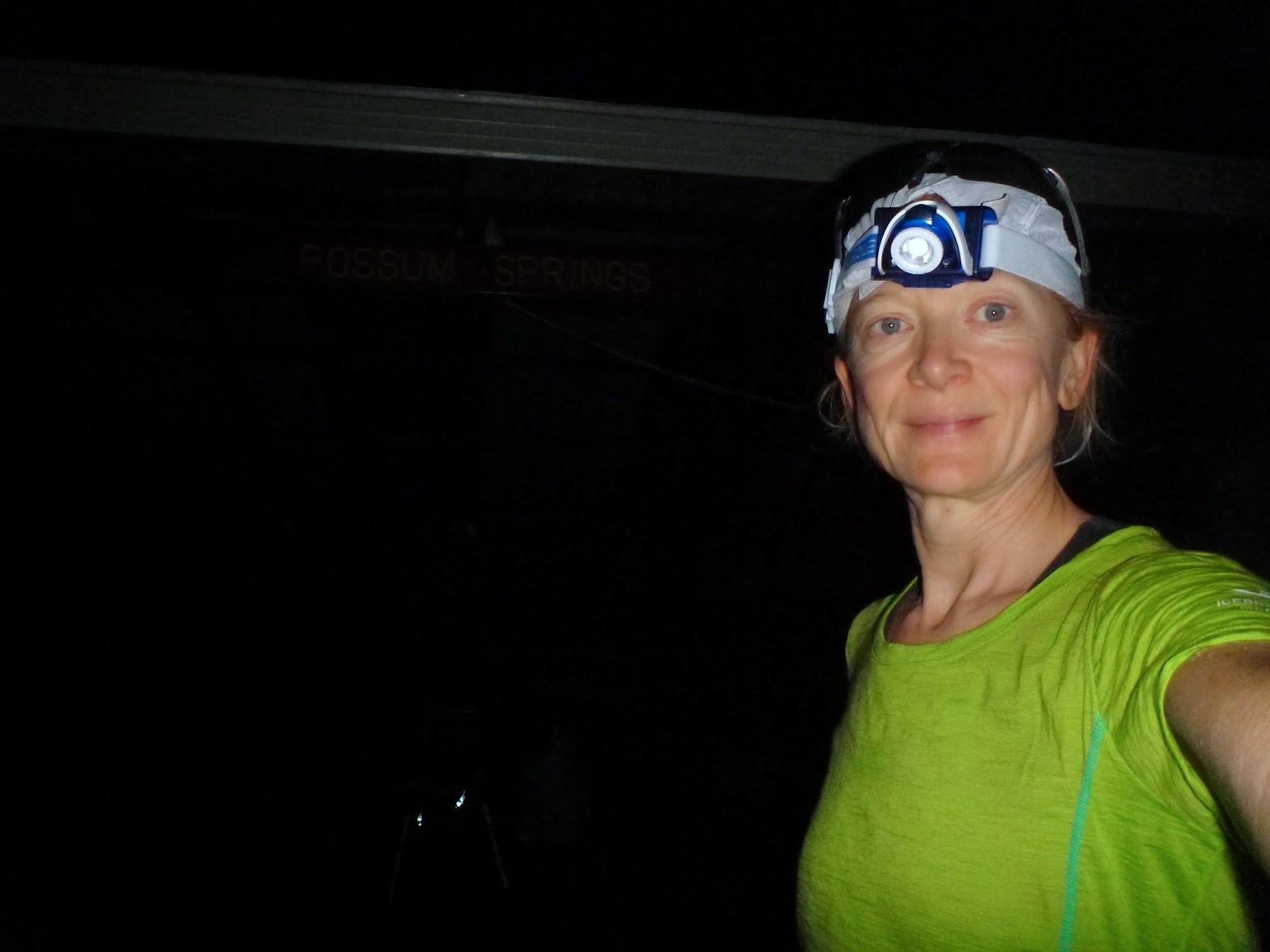
LED Lenser SEO7 (+ spare batteries)
Montane H2O jacket (would use their heavier model for FKT)
Ryders sunnies
Inov-8 Roclite 305s (an old model) - want to try x-talons next time
cap, quick-dry towel and toiletries

Monday, October 27, 2014

Posers!

A while back I was listening to a fascinating TED Talk on "power poses" by social psychologist Amy Cuddy. Recently, an article on the same thing passed over my desk.

Anton Krupicka DNF's Nolan's 14, 2013. Not a power position.
And then I watched a quite dramatic shift in running strength and stamina in a mate, after making a comment to them during a big hill climb on a run. The mate had confidence issues. Something most of us, including me, have gone through. That defeating self-talk that goes something like this:

This is stupid. Why am I even here? I'm slowing down the group. They don't want me here. I'm so slow.

I watched the mate climbing the hill, adopting a very hunched over posture, head down, arms limp. I sheepdogged back down, as I typically do if there's someone behind on a group run, and spoke from my heart. Before my brain even registered what, if anything, might be the best thing to say. Seeing that body language was like looking into a mirror in my past and the base brain in me fired up. I can't remember exactly what came out but it was something like, "It's fine to walk, but POWER walk! Use those arms! You're not a zombie!"

Over the past two weeks, I've seen this runner's posture completely transform on runs. When I sheepdog (which seems to be happening less, because I swear they're stronger and faster already), I hear a quiet self-talk, "I am not a zombie!" The arms are swinging and boy, oh boy, there's power! Physical and mental power.

The mind influences the body and the body influences the mind. Amy Cuddy's research showed that individuals who adopted "power poses" for just two minutes increased their testosterone levels (measured in their saliva) significantly, whilst decreasing cortisol levels significantly. Testosterone is essentially our power and dominance hormone. (Yes, even girls have some and it's important to.) Cortisol is a major stress hormone. We want low stress but high feelings of power in our lives. Power, for those squirming in their seats, is not a dirty word. It does not mean coercion or cruelty. Power is simply "the ability or capacity to do something or act in a particular way." It is the ability to influence the course of events.

Power poses are simple. Essentially, think silverback gorilla. Expand, make yourself bigger. Arms wide, feet apart, standing or sitting or laying down.

Wide legged, wide arms. I'm confident. Lost Soul 100 Miler, 2013 (new CR)
Amy Cuddy did not "discover" power poses, but she sure highlighted the important relationship they have to self-confidence, risk-taking, and success (e.g., nailing the job interview). She put data to what Buddhists have been saying for over a thousand years. The mind influences the body and conversely, the body influences the mind. It's not a one-way street.

Since I'm a runner, I love to see how and where science can play at improving my performance. Most generally, how it can improve my FUN (which can relate to performance, yes).

I went back to have a look through my photos from start lines to see whether I could spot any relationship between my pre-race posture, my mindset at the time (recalling how I felt in terms of my race confidence), and my resulting performance. I also had a quick look at a few elite start photos from other races, just to see what other anecdotal information I could find. Naturally, I know I probably have a huge selection bias here, but rest assured I'll be keeping an eye on the postures of my fellow competitors on race morning ;) Whatever you do, don't fold your arms over your body (Anton Krupicka fully admitted going into the 2013 Speedgoat 50k with "an undue amount of competitive angst." Look at the photo below - it shows.) And whatever you do, don't touch or hold your neck with your palm. That's the lowest power posture of all and I'll be onto you!
Speedgoat 50k, 2013, elite field, start line. Spot the winner (even his feet are wide!)

Fake it til you make it. It's real. Be a poser. Give it two minutes before the start of your next race, tempo session, or tough long run.

And when you catch yourself at a low moment during that race or run, force a smile, force a laugh, and lift your head as if a string was pulling you up through the spine and crown of the head. Swing your arms!

I'll leave us with a wonderfully appropriate quote, attributed to so many, that I can't reliably name one:


"It's easier to act your way into a new way of thinking than to think your way into a new way of acting." 
Practice this pose BEFORE your next challenge :)