"The goal is to become the unique, awesome, never to be repeated human being that we were called to be." -Patricia Deegan

Monday, March 24, 2014

Make Mine a Double, Neat!

Yes, I used to enjoy a glass of unpeated whiskey (neat) now and then. Particularly on those long, cold, Canadian winter nights.

This one's for you, Mal.

But it just so happens that my cravings nowadays for a "double" must have something to do with running! In this case, it's the Coburg 24 Hour Carnival approaching on 5-6 April. My plan for this race was to run 12 hours and then stop - I really want to do a specific 12 hour event because I haven't yet. I have some goals :)

The plan after that was to run the Sri Chinmoy 24 Hour in its entirety in mid-June, with Rolf as steadfast crew. He's the one who has crewed me through all my long events and knows me and my running so well (ummmm, okay, and perhaps he's the only one who would put up with me for 24 hours!) BUT, it so happens now that my most favourite crew is not available for mid-June....

So, Coburg 12 hour - make it a double! I'll just have to get the 24 hour race out of my system early so I have my preferred crew and thus the best possible setup. Since the event is run entirely on a 400 metre track, it is "neat" (i.e., not "on the rocks" as a trail race would be!).

I can't really see a reason why the extra two months would be necessary to prepare for a 24 Hour race at this point. My fitness is good, my mental state is good, my crew is good. And Melbourne weather is chronically cold, which is good ;)
Model & Dumpster Diver? (Really, those are dumbbell stains!) 

I've been tackling the brutal strength training again to make my core and upper body rock solid. I think it makes my mind rock solid, too! Nothing like being reduced to a moaning puddle of sweat on the floor, trying not to burst into tears when told there's just "one more thing to do" by the tiniest, perkiest, fittest little midget around!

Last week I headed out for my third go at the Masters 10k State Championships. I ran them first in 2011 when I had just joined Masters Athletics WA. This was such a good move and I'm very grateful for the few running mentors I've had who pushed me towards doing some speed work (even though I complained, "But I'm an ultra runner!).

At that event in 2011, I was happy with my 43m58s time and even got "gold" in my W40 age group (I need to acknowledge that the fields, especially female, sadly tend to be very small). In 2012, I missed the State Champs due to my recovering Bibbulmun foot/compartment syndrome. But late in the year I ran the John Gilmour 10k race around the track in 42.10. Again, I was stoked with my time and my improvement. In 2013, I was back at Masters State Champs for the 10k with a time of 41.59.8 (love the milliseconds). Also good for 1st female. Considering I always go into these on the back of regular volume and they are always on a Thursday night after my Wednesday hill night, I am especially pleased to see increasing speed.

This year's result? 41.11.0! (1st female as a bonus again). Coming into the race with very tired quads and adductors, I thought I should expect nothing more than to hold onto my 2013 time (and try not to run like a cowboy just off a day in the saddle). But despite a few hiccups out there, I ran mostly the race I thought I was capable of given load and such. One day, maybe one day, I will actually taper for a 10k...and run it somewhere COLD, rather than 30+ degrees! :)

WA Masters 2014 10k State Championships
Well, it's off to the ice cup massage for me before a tempo run tomorrow. Let's hope the legs would like to come along for the ride!

Perhaps I'll do some visualisation for the race, too. I mean, with a name like the race has...24 Hour "Carnival" it's obviously guaranteed to be a fun ride! ;)

I do expect to look like I'm hung-over the next day, anyway.

Anyone got a cure for hangovers? A little hair of the dog?

Tuesday, March 11, 2014

Negative Splits Aren't So Positive

Running with mates not long ago, a topic that sparks no end of debate came up: how do you pace yourself for a race, especially an ultra?

(1) Run as evenly as possible.

(2) Run hard from the start and try to hang on.

(3) Run easy to start and "negative split" by running further/faster in the second half compared to the first.

Given my recent 6 hour race and thoughts of 12 and 24 hour races dancing in my head, I thought it would be good to actually review what the research says on this, rather than just keep talking "folklore." I've been part of several conversations that sound like this: "Well, you know X runner just did Y (time/distance) at Z race last month. His splits were A/B, so ...."

I thought the research could given me a greater sense of what best practices might be.

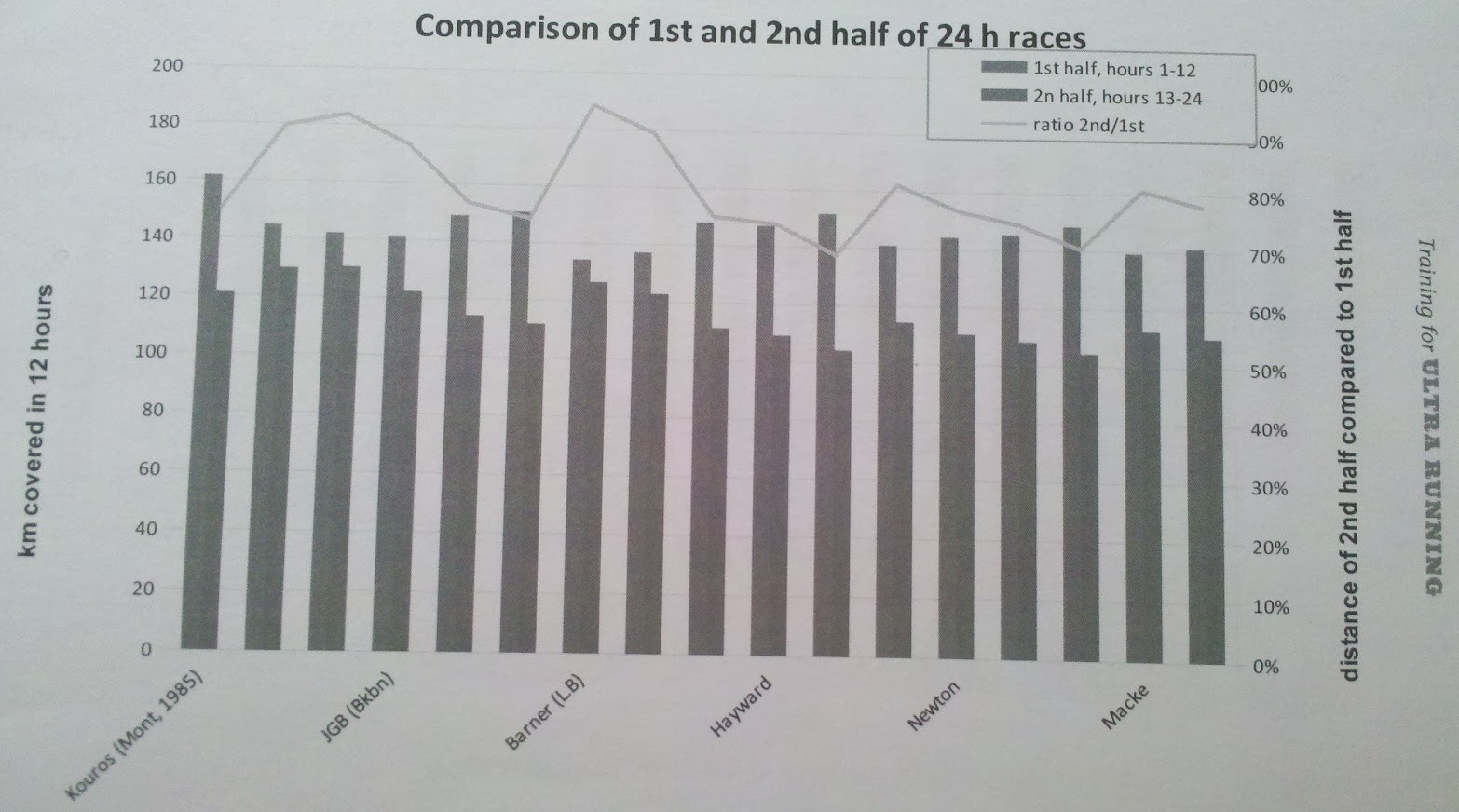
First stop, Andy Milroy's 2013 book, "Training for Ultra Running." There are some wonderful graphs in the back appendix showing what top men, including Kouros and Newton, have done in several of their 24 hour events. Comparisons were succinct, in that they show splits only for "1st half" and "2nd half" and the ratio of performance derived from each. The average ratio for 17 performances was 87.4% for the 2nd half (distance run in 12 hours) compared to the 1st half. Only one of the 17 performances included a negative split (103% in the 2nd half).

First half compared to second half. Start too hard, just finish weaker. See that trend?

Second stop, I went to DUV statistics and pulled up the 12 hour splits and 24 hour distances for 7 of the world's best recent females, including Suzanna Bon and Sabrina Little. None of them had a negative split. Their average ratio was 87.9%. The same as men, essentially (though I took a smaller sample). Interestingly, for those who know of world record holder Mami Kudo, her 2010 and 2011 Soochow performances had ratios of 81% and 74%, so when they are added to the women's results, the female ratio drops to 85.6%.

So far, it seems that elite 24 hour runners do not negative split and they slow by 12-14% in the 2nd half compared to the 1st half.

Out of curiosity, what about my own few 24 hour races? Sri Chinmoy 2010 (first ever) = 76% ratio. World 24 hour 2013 (bad mental mojo) = 77%. At first glance, you either guess I'm going out too hard or there's something else causing me to blow up in the second half. In 2010, I ran exactly what I predicted. For my first serious endurance event, I think 76% was acceptable. In 2013, I expected much more from the 2nd half, but had 3 "sulk" breaks due to the bad mental place I had been in over many months of "over-lifing." I had expected something more like 84%. We have yet to see if I really can perform better, as I think.

1995 IAU 100k. Group A was fastest, G slowest
Back to the research. Next up, a review of some research studies. In sprints, my quick glance says runners start hard and slow down (e.g., over 800 metres). In longer races, say 5k and 10k, both "moderately trained runners" and world record holders do best by running hard to start, fading a bit, and running hard to finish. Their performance looks like a U shape (with the second 'up' swing in speed not necessarily reaching the height of the first on a graph!). Maybe saying it looks like a backwards tickmark (checkmark) is more apt.

What about events that are even longer? And how hard of a pace is "hard" for starting?

A study published in 2004 analysing the performance of 67 male finishers at the IAU 100k world championship road race in the Netherlands found that the best performing men not only started faster but maintained their starting speed for at least half the race, and finished within 15% of their start speed. Hmmm, 15% drop - that's about what we saw in the 24hr runners. The worst performers at the 100k championships couldn't maintain their pace for very long and dropped pace markedly over the distance. So, although they started out "easier" than the "A" group in terms of pace, perhaps it was still too hard of a pace for their own ability. And/or they lacked the endurance to hold it?

Another study (2013), rather elegant, had cyclists do a self-paced 20k time trial. Get it done as fast as possible. Then they made them do it again later, twice, each time with a different rule. Rule one was that their bikes were set to an average power equated with their original self-paced ride...they just had to ride to 20k again...and keep going if they still could. If they could go further when on the "even pace" rule, then even pacing must be more efficient than doing their self-paced thing. The "Rule two" trial was that they were supposed to stay at their average power but the bike wasn't set to it - thus, more brain power was required to try to stay on that pace. But at the same time, minor variations could then be possible. The result? Nine of the 15 guys QUIT before 20k! The quitters only got 10-15k done. They also reported more negative feelings during the "even pace" rule trials (for both rules) and their rating of perceived exertion was higher. The DNF guys were all guys who had started faster in their original self-paced ride. They rode the 1st third of the distance at 1-2% above their mean power output for the 20k. The 6 guys who managed to finish the 20k during the "even pace" rule had started conservatively in their original self-paced time trial (riding the 1st third of the distance at 1-4% below their mean power). AND, notably, those 6 guys were able to cycle 20-27k during the "even pace" rule. This again provides evidence that trying to run conservatively or "even" at the start means one will be left with too much petrol in the tank at the end...under-performance.

I thought I'd look at my recent 6 Hour performance, which I felt was a solid run for me. I ran 74.930km in 6 hours. That's a 4.48min/k average. The 1st third of the event I ran 25.6km. That's a 4.41 pace. And that just happens to be 2% faster than my average.
My Coburg reverse tickmark

The research suggests that had I run up to 5% faster in the 1st third, that is a 4.34 pace, I likely would have blown up. My "central governor", the brain process coined by Tim Noakes, would have choked me along the way. It's the theorised governor that keeps a watch on body systems with a view to keeping us from killing ourselves. It's monitoring our body heat, sweat rate, muscle work rate, carb stores, levels of oxygen in the blood, and so on. It sends us "tired" signals to slow us down, recruit less muscle and cause less strain to the heart. Although we are "self-paced," our pace is still decided by this purported governor, which analyses what's "safe." And that's why, if we are suddenly told the finish line is further than we thought, we feel more tired! The governor makes a new calculation, given the change in one variable, and says, "Well, given the rest of the conditions remaining the same, we must slow down to survive." But, if we then get some more glucose, the weather cools and we are sweating less, or someone tells us there was an error and we are actually CLOSER to the finish line, we SURGE! The governor adjusts the "fatigue" signals, knowing it's now safe to up the pace. And that gives us the parabolic/reverse tickmark profile for so many of our ultra distance events.

In sum, my take-away messages from the research, my experience, and the "folklore" chats with mates are:

1. Run well within yourself.

2. Given point #1, the starting pace should feel comfortable and easy, but will still be faster than your overall average pace for the race. How much faster? In races up to 6 hours, appropriate pace may equate to about 2% faster than the anticipated mean pace for the entire race. In races of 24 hours, based on a quick analysis of those top women's 24hr performance at World 2013 Championships, the first 6 hours was done at an average of more than 30 seconds faster per minute/km. In other words, they were about 10% faster (range 6-13%) in the first six hours compared to their average for the entire race. Extrapolating to the 12 hour event, one might start at a pace that was 5% faster than the anticipated average race pace.

3. At the half-way point, it shouldn't feel "hard" yet (this little rule of mine seems to fit for races from 5k to 24hr so far).

The Coburg scoreboard at 3 hours, which I saw as a photo post-event
4. Run your own race. This has been hammered home again and again to me. I found out at the Coburg 6 Hour last month, I was tied for 5th place overall at the halfway point. By finish time, I had passed three of those men, to move to 3rd overall. I ran my own race and didn't get caught up in who was on what pace/distance/position. I've also been on a track enough times to see many of the walkers in the concurrent race-walking events out-perform runners!

5. Endurance improves over time/experience. My ability to sit on a pace for a certain length of time has continued to improve as I've gotten fitter and the body has adapted.

6. Keep the perceived exertion down. Take caffeine, take beetroot juice, tell yourself lies about how easy it feels, and have everyone else tell you how great and effortless you look :)

Tuesday, February 25, 2014

If You Don't Like Your Life, Change It: Coburg 6hr 2014

Here I am two days on from the Coburg 6 Hour Track Championships and I feel like I'm struggling more with my blog post than with the race. Sitting down to type now, after scribbling down various thoughts over a couple days, I'm none the wiser as to what I'm about to write. Why is that, I ask myself?

I think it's because the story seems so undramatic. There was no big to-and-fro with another female racer, there was no terrible weather or bad race management, no bad lighting, no vomiting or bloodletting, no cries of agony or ambulances. There was just this little redhead going around and around and around. 187 times.
Unadjusted Garmin file - massive over-reading typical of track racing

A little redhead who planned this race a year ago, but gave up when Melbourne had a heat wave. Who burnt out late in 2013 and had some disastrous training weeks October through December, bottoming out one week with a measly 32k.

Seriously regrouping through January and February, both mentally and physically, I aimed for Coburg's 2014 event. The weather agreed, so I flew over east. Then around and around I went, taking a 125ml bottle of Perpetuem every 15 minutes from my crew, standing diligently within one metre of the crew table, abiding by IAU and AURA rules. It was a regimented and simple world broken down to counting laps: ensuring all early ones were about 1 minute 50 seconds and late ones were no more than 2 minutes each. Counting off 2 minutes at a time for 360 minutes. Time goes surprisingly quickly, actually.
Crew gets a rare moment free to snap a photo

Chapstick, 1min 50. Caffeine, 1min 50. Perp, 1min 50. See hot air balloons rising, 1min 50. Check form, adjust left wrist, 1min 50. Notice powerlines for first time, 1min 50. Hear birds chirping, 1min 50.

It was a race in which so little happened and as a consequence so much happened. I slept the night before better than I ever have pre-race. My heart rate was barely elevated with nerves. I didn't really hit the "business end" of the race until 4.5 hours in. I experienced a few funky nerve twitches through the left hip down to the top of foot (effects of repetitive running) and some quad fatigue and nasty calf tightness, but those things only registered at the "mild" discomfort level in my brain. The weather, especially by Perth standards, was downright cold (15 degrees) for the 6am start and didn't get uncomfortable until 10 am (21-24 degrees, which is certainly uncomfortable for me at race pace).

I had calculated I should be capable of somewhere between 72 - 74km, with 74 being on the end of the "perfect conditions" continuum. With disrupted training and a short lead-in time, I saw things as less than "perfect." I also developed a tight tib post before the race that was less than perfect. I'm a realist, not a pessimist.

Pre-race with Barry Loveday, amazing athlete, novice crew!
But in my favour were solid training sessions through January and early February and mental strength (really cutting down on the over-commitment thing). The realist put those into the equation, too.

And so, quietly, with just the timekeepers and their stopwatches clicking away, at 3 hours 55 minutes and 51 seconds, I surpassed the Australian W40 50k track record which belonged to Helen Stanger for 20 years. In fact, this time represented a PB for me at the 50k distance, whilst taking about 16 minutes off the record.

Perp, 1min 56 sec. Pour water over head, 1min 57 sec. Sponge, 1min 56 sec. Check form, adjust hips, 1min 56 sec. Word to crew as passing the table, "I'm going into the business end. Stay switched on!" 1hr 58 sec.

Rainbow light. Few will understand. That's okay.
20 minutes to go - time to push it out. So many cheered me on, and in turn, I tried to bring a few with me. "Come on, let's finish this thing!"

Then, "Bang." The gun sounded and I dropped my sandbag. Coincidentally beside my crew table. For a moment, I felt there would be tears, then they were gone. Barry went to check totals. 74.8k (still provisional at the time of writing) plus the distance to be measured from the start line to the crew table where I finished (provisional total 74.930km).

I had broken Helen's 20 year old AUS W40 track record of 69.400km (which I also broke at Moe in 2010 with 70.400km, but I wasn't an Aussie then. Now I have taken the pledge, even if my accent is still "Texan Irish.") I had reclaimed the CAN W40 record of 71.699km, set by Christine Torres in 2013, when she broke my 2010 record. I had broken the CAN Open record of 73.264km belonging to Ashley Evans, a 29 year old at the time, who set that benchmark 20 years ago.

Subsequently, I was told that I have run the third largest 6 hour distance in the Australian all time female track rankings, after Linda Meadows' incredible 78.742km and Lavinia Petrie's 76.042km.

Once, several years ago, I sat in a chair late at night, with a boyfriend passed out in a chair across the room. In dejected anger, I scrawled on a paper adjacent to me, "This is my #@*!$*# life." I went to bed. In the morning, I got up and walked past that paper. Written underneath it was, "So, change it!"

What good advice. We are, after all, the only ones who have the power to change our own lives.

Sunday, February 2, 2014

Believe and You Will be Healed!

I have been meaning to finish my research into heat acclimation/acclimatisation and blog on that, but since we're so well and truly into summer here in Western Australia, with 10 days above 35 degrees in January, it seems a bit late!

Thus, it's more fitting to talk about ice baths! :-)

Or more appropriately, "cold water immersion" (CWI). I, myself, have had no less than three ice baths (CWI experiences) this week. Essential to me, as I've also just finished my highest mileage training week ever, hitting 165km + 4400m. Woohoo! Feeling good.
Canadian mountain rivers are NOT 14 degrees!

I've been aware of cold water recovery methods since I started running trails in 2006, watching my trail running buddies in Canada happily jumping into near-frozen streams in the mountains after long runs. A few years ago, I received a lovely phone call from a fellow who spent a lot of time helping Helen Stanger (AUS) train through her incredible ultra career. He asked, "Do you use ice baths for recovery?" and went on to state how important he felt they were for Helen. Last year, being "bathtub-less", I bought a large bin and started having some ice baths outside. I threw a thermometer into the water often, as I had it in my head that I should aim for 10-12 degrees.

But despite all the anecdotal reports from athletes raving about their love of ice baths, research has been quite contradictory. I decided to delve into it.

The main problem with the research is that it's all over the place. Immersion in water ranging from 0 degrees Celsius to 24 degrees Celsius. Full body immersion vs legs-only. Five minutes vs 20 minutes. Men vs women. Trained athletes vs novices. Winter swimmers vs rugby players. And test exercises that are commonly used as a way to measure "recovery" include eccentric muscle contractions with weight (e.g., using the quad). Hardly a practical application for most athletes. And these recovery "test" exercises are administered anywhere from 5 minutes after CWI to 24 hours after. No wonder we can't make sense of whether ice baths are good for us or not.

Pre-bathtub days, when I had to feed mossies, too
In one review (Beakley and Davison, 2009, Br J Sports Med, 44, 179-187), the authors report on what happens to our bodies when we immerse them in cold water. The stuff that's not so good - "cold shock." Increased heart rate, increased blood pressure, increased respiration, increased cortisol, decreased cerebral blood flow (a few people nearly passed out at 0 degrees), and oxidative stress. So why would we do it? Because the apparent benefits include vasoconstriction (constricting blood vessels), which should help remove metabolic waste from legs, decrease swelling/oedema and inflammation, and decrease muscle soreness. It reduces our core temperature, which gets us recovered and ready for exercise again sooner. Even the hydrostatic forces - the pressure of the water - pushes body fluid from the periphery to the core, which increases central blood volume. And cold water/ice has an analgesic effect. Who doesn't like a little numbing? :)

What I've taken from the research indicates this:

  • Water temperature of approximately 12-14 degrees Celsius may be optimal. Colder, and anything approaching 0-5 degrees Celsius, induces too much stress. Just like most everything in life, moderation is key. Running is good, but too much running results in overtraining and injury. CWI is good, but too cold results in shock. One should not have a "shivering" response, as evidence indicates it's associated with free-radical production. 
  • Immersion for 10-20 minutes appears optimal, at the temperature above.
  • Training/racing should not be expected to be undertaken immediately afterwards, as cold muscles will have compromised contraction abilities and slow nerve conduction speeds (several studies had subjects "test" immediately after CWI). Core body temperature will naturally rise to baseline within 24 hours. It may be possible to speed this up with a warm shower (the idea of "contrast water therapy," which I won't go into).
Stream crossing mid-run. It really IS hard to move after this kind of CWI.
  • Your belief in the power of CWI makes a difference. Cook and Beaven's (Br J Sports Med, 2013, 47, 705-709) novel study on CWI at 14 degrees for 15 minutes (vs other options) found that the rugby players who "liked" the ice bath had better sprint performance the next day than those who didn't. So, the ice bath helped, BUT believing in the ice bath appeared to help even more. Believe, and you will be healed! Use the placebo effect to your advantage, as it can also trigger your brain's "reward centre," which can then cause your body to dump some nice opioids into your system. Mmmmm, endogenous opioids....
  • Immerse only over the hips. Do not immerse the "core" area including the major organs such as heart and lungs. There is no evidence of benefit to runners/athletes generally in doing this and it looks to bring more potential for harm/shock.

Finally, prepare adequate reading material, such as your favourite ultra running magazine, and ensure no small, impressionable children are nearby as you take that first step into the tub!

Saturday, January 11, 2014

Climbing Out of a Hole and Up a Mountain

It's been so long since I've posted, I was torn by whether to write about the heat acclimation/acclimatisation research I've been reading about, or the ice bath research, or ... and then I thought I just need to start at the beginning.

Spider on trail, a common sight (see his back spikes?)
It seems like the beginning. It has nothing to do with the new year, per se, but it's almost like a new start, refreshing my connection with my blog and its readers. And I rather feel like I've just gone in a complete circle and am back at the beginning.

Although I've been blogging about my "over-lifing" injury since at least April 2013, I did not realise the extent I needed to go to get my act together. One of the problems with being focussed, determined, committed, organised, and efficient, is that everyone expects that and counts me as "totally able." Me included. It's a natural expectation, as I've been "totally able" much of my life. So, although I kept making passing comments like, "I don't think I can keep this up" or "I need to quit a few projects," I just received well-meaning advice along the lines of "I'm sure you can do it. You're very [smart/organised/efficient]." I don't blame anyone for that - it was truly encouraging advice. But I made the mistake of trying to believe it and digging a deeper hole for myself.

In April, I pushed some things off my plate, as I promised, but then brought more things back in to crowd what was still a full plate. I got another stomach ache ;) The mental stresses impacted my game at World 24 Hour, and although in 2013 I set 7 or 8 new CAN and AUS records, from 50 Mile to 24 Hour, I remain disappointed with the results, when the maths certainly showed I was capable of better (the maths didn't have a factor for poor mental state). It's not a "crushing" sort of disappointment and I am not looking for sympathy or reassurance. It's just my practical mind, looking objectively, and knowing what the potential was if I hadn't "over-lifed" incessantly.

I built a ladder to get out of my hole whilst overseas July-September. (It was a big hole, so it required a ladder). I had heaps of fun running new mountainous trails in Europe and Canada, with old and new friends alike, and with my amazing partner. We set goals to find foods to forage on every country's trails and to eat sandwiches on mountain summits. I had two very pleasing races, with a Swissalpine podium and Lost Soul Ultra 100 Miler course record. Irontrail in the middle was an excellent race and well organised and I still don't regret my decision to quit, as it just wasn't worth the maceration I was doing to my feet and the overall tendon/muscle/endocrine damage and resultant recovery time another 12-14 hours of hiking was going to cause. And I was done with hiking.

Running down around Walpole with the giant trees. In love with nature.
Back to Oz and ... whoops!

Ill-constructed ladder, made too quickly. No attention to detail. Top rung bust and down I toppled, back into the hole.

Write up and submit PhD (turned Masters of Philosophy). Move house, again, second time in 8 months. Take 4 home-based businesses along. Train. Race direct. See clients. Give presentations on things running. Take running trip with mates to Razorback ultra. Volunteer with AURA. Coach.

Hey, how did I get here again? Back in the hole; got some better tools. Made a better ladder. Out of hole.

Oh, look, there's a mountain. Damn. Spit the dummy. Tantrum. Okay, I know how to climb mountains and I have all the tools for that already. Sync my breath with my step. Look up. Agh, I can't even see the summit. Look down, breathe. Use the poles. It's hot. Take in water. Wave of nausea. Slow down and rest on a false summit. Get a glimpse of amazing view between the trees. Spectators cheer, "Hop Hop Hop! Bravo!" There, up ahead, it looks like the top. Can't be sure 'til I'm there and can see over the other side. But I know now that I can get there.

Yay (I think)! I finally have a home with a bathtub!
After six weeks of training weeks in the 30-60k range,except for the Razorback week, where I snuck (sneaked) in a bit more, I was able to get a couple weeks over 100k again, plus elevation. Ramping it up quickly is a risk, so I'm monitoring it very carefully and employing all the tactics (ice cup massage, ice bath, massage, sports chiro, Udo's Oil, good food, compression, roller...and tomorrow - needles for good measure).

2014 races/plans - I've signed up for the Coburg 6hr on 23 February, but not sure I'll be in 50k/6hr form in time. There's a lot of loss that's happened over a couple months. But having the goal is nice for my brain and if I'm not ready, I won't go. Or if I'm ready and the weather doesn't comply (as in 2013 - when I ended up running Perth 32 instead, and got that wonderful experience of chasing the lead bike). I've also signed up for the Sri Chinmoy 24hr in June in Sydney. I want to do a proper 24hr. This is a major goal for my year. Razorback Run 64km (the Vic alps trail event I did as a training run with mates in November) is on the radar for March 2014. Fastpacking 5 days in the Dolomites August 2014, roughly 30km +2000mtr/day with one change of clothes. That's one's pretty much non-negotiable :)

Bibbulmun track, south coast. Do I feel like 1000k again? Solo?


And then, there's this thing that keeps coming up.... FKT (Fastest Known Time) attempt on the Bibbulmun 1000k - self supported this time. April would be the month. Burn out makes a two week 1,000km solo slog through +20,000 metres of hills, marshes, ticks, flies, sand, and pea gravel with 12kg on my back sound oddly appealing. We'll see, won't we?

Next time, let's talk about that research!

Tuesday, December 3, 2013

Public Service Announcement

We interrupt this complete lack of posting for a brief word from our ultrarunner.

If you're not having fun, you're doing it wrong.

That's what I said at the race briefing for WA's first night trail race - the Perth Trail Series' Moon Shadow event just over a week ago. The comment was meant to remind people that if they were nervous and freaking out on the trails running at night (many for the first time), they should slow down and enjoy the sights - get the fun back.
Having fun. Razorback Run 64km on the Victorian high plains 30 Nov.

Turns out, this little statement is a perfect adage for life as well. And for much of the last year, I've been doing it wrong. Thus, this past 10 days has involved some more radical "quitting" and readjusting on my part. I've got a vision developing of the future I want to see in 2014 and I've not been creating it!

Fulfilling this vision, you will see a lot more of the blog again, complete with my old research analyses, race reports, reflections, tips, and such. But I have to package up a few other projects this month and send them on their way first.

Now, back to your regularly scheduled program. I hope it's not a repeat ;)

Saturday, October 26, 2013

The Rest Month (Don't Try This at Home)

Prairie Mtn sunset with friends - the Leki poles in my pack, of course! ;)
After the Lost Soul Miler in early September, my plan was to keep running (or power slogging as need be) in the Canadian Rockies until leaving Canada. I thought the tendons and ligaments would be well due for a bit of repair time after the wonderful adventures of Swissalpine, Irontrail, and Lost Soul, but... I just HAD to squeeze out every last drop of alpine trail running goodness I could! Western Australia, I  love you, but your 200 metre pea gravel climbs just aren't the same as mountain running.

I took a few days off, then we ran/hiked up Prairie Mountain on Wednesday night (2210 metres). Saturday saw us on the spectacular Mt Bourgeau summit in Banff National Park at 2930 metres. It was only a week after the Miler, but I wasn't the only trail junkie with a problem - another girl in our group was just back from the Leadville Miler and with that had completed the Grand Slam. Then Monday we did a loop incorporating the North and South Buller Passes when a thunderstorm and hail came through - very exciting! And a good reminder why we need all that emergency gear in our packs! The rest of the week was rather tame, but then we were back out at the very famous Lake Louise, just west of Banff, for a tour of all the local trails, including some tea houses that date back to the early 1900s and Fairview Mountain (even with slightly foggy/snowy conditions, the views were still more than fair at 2744 metres).
On the way to Mt Bourgeau- the hangglider pilot looks for alt ways down

That left one day to recover and one more day to get out on the trails. Junction Mountain, a fire lookout at 2239 metres, was the final choice. Coincidentally, the only runner with a Tuesday off work I could talk into an outing was Dave Proctor, the bloke who won the men's division of the Lost Soul Miler. The two of us were a pair in recovery, that's for sure! I'm sure it was partly psychological, that my brain knew my legs were getting a break after that run, but I felt bagged! Yet it was still a glorious adventure, which started by fording the Sheep River (due to early season floods, the bridges were out in many areas of the backcountry). At the fire tower, we met the ranger woman, who had spent the season up there alone. The last person she'd seen had been a few weeks prior when she had a helicopter food drop - no one was coming in because the river was too high to ford. But we managed a late season attempt and though it was slightly intimidating for me (fast water to my thighs), a hand from Dave (much taller than I!) helped me get across before I was frozen numb! I have to take baby steps in swift and slippery conditions like that, so I don't lose my balance.
The Sheep River. More serious than it looks - at least at my size!

Back to merry old England, where autumn was in full swing. I pulled back the mileage, which wasn't hard, as I didn't feel like contending with the brambles and stinging nettles much, anyway. The sky was so low that I imagined it was like England tries to hug us with her skies, like a mother afraid we'll leave home! (As, in fact, many do leave that heavy, grey hug). The weekly mileage dropped to 48k, with just +1200m. 

And then another day of pseudo-altitude training on Emirates Air brought me back to Perth. My plan was to continue another three weeks of "relative" rest. In my head, I was thinking 50k/week was probably good. However, the reality was tougher to engineer! Just one run with mates on the weekend was giving me half my weekly distance. (Well, yes, you needn't point out that I should have been doing a shorter weekend run.) Add in a Wednesday night run and...well, that created a rather unbalanced "rest" of long runs combined with multiple days off. I do NOT recommend this! My body felt worse than ever. My back tightened up, my calves tightened up, and then I got a flu! My first flu ever. The flu wasn't bad, actually - it was kind of interesting. It was just an all-over muscle/joint ache, but my head was still clear. I learned that the muscle ache is theoretically caused by dehydration, brought about by fever. That made total sense, as when I woke up that day, my weight was down 800 grams from the morning before. I knew I hadn't calorie restricted by 3000 calories that day! So I gunned heaps of fluid all day and felt much better. The flu became a cold, but didn't stick around long. Not with my naps and cinnamon regime ;)
Don't be frightened, it's just a mulberry addiction. Anti-oxidants, you know.

And not long enough to make me miss out on WA's last rogaine of the season - the spring 12 hour. But how could I do a 12 hour event on a "rest" month? Hmmmm. Not easy, no, but I do like a challenge. So I paired up with a mate who had never run 12 hours straight before. I figured that would slow me down. And I picked the nastiest section of the mapped out area to start with, which I figured would be harder and keep the miles down. However, I didn't count on him being such a good navigator! Between us, we had pretty good luck finding the controls and managed to still net 54km + 850m with a lot of bush bashing.

And so, with that, I figured my ruse of a "rest month" was well and truly exposed and I might as well book my first brutal training session in 3.5 months. A few days ago I hit the gym for five rounds of pull-ups, push-ups, sit-ups, and squats with weight. The next day, I struggled to get out of bed and cursed Rolf when he made me laugh. Those abs have been tucked away nicely into a kilo of fat again and let me know they were none too pleased with the new agenda!

So what is the new agenda? Well, I think it starts off with the Narrabeen Allnighter. After a delicious season on the trails, I feel the siren call of some speedy road and track goals (well, speedy for an old lady like me!). With summer on its way (the flies blown in on the easterlies this week are portending - at least I think that's what it was when one went up my nose today on the trail!), it gets hard to find road and track races in Australia. It's not the season for speed - or exposure. It's the season to run trails, shaded in trees (you hope). Nonetheless, one of my current A goals is to run a sub 9hr 100km again. For anyone who is interested in the numbers, that's a Category B level with the International Association of Ultrarunners (IAU) and current AUS "A" qualifier for team placement. My last official 100km was my 8hr52 CAN W40 record from Coburg in 2011. And the World 100k Championship is in Latvia next August. That's interesting :)
I wonder if Latvians use cobblestones. I don't like cobblestones.

Narrabeen Allnighter is an overnight 12hr event near Sydney NSW, where I could get a 100km split recorded. The million dollar question is: Do I go hardest for the 100k and stop (reality is, I learned, that if you go your hardest for that, there's nothing left to continue with the 12hr)...or go "hard enough" with the 100k but keep enough in reserve to nut out the best 12hr possible?? I've never done an official 12hr (my best 12hr distance is 122.649km as part of the World 24hr this year). So, the 12hr challenge sounds like the more interesting, doesn't it? How far could I go?

Time to ramp up the mileage and see if the body agrees there will be a party on 4 January. Assuming the weather fairies also agree to provide a nice, mild night conducive for 12 hour running parties.