"The goal is to become the unique, awesome, never to be repeated human being that we were called to be." -Patricia Deegan

Wednesday, August 14, 2013

It's Just Running (or hiking, as the case may be): The Irontrail Story

The night before Irontrail, my partner and crew man extraordinaire said something to the effect of "No matter what happens tomorrow, I'm proud of you."

Pride: A feeling of satisfaction or pleasure over something regarded as highly honourable or creditable.
Day before. Turns out, this one IS beyond my (patience) limit! :-)

Thus, my reply: "It's just running."

And with that, we went to sleep.

In the morning, I woke and still did not feel like racing. It could have been a combination of several factors...the cool, rainy skies for the past two days, which tends to make one want to curl up with a book. Or it could have been my period (I don't mind being a girl, but in my next life, a boy body might be more convenient). Or, maybe it was just that I didn't feel like it. I considered whether it could be overtraining, but knew that wasn't it. My resting HR had dropped back below 40 within two days of Swissalpine and I was excited to be out running the trails again in no time. My stress levels were low, my mood was great, and I was well rested. 

I decided to stop over-analysing it. As I wrote earlier in my "eggs for breakfast" analogy... If I went to bed one night saying I was going to have eggs for breakfast, but woke up and didn't feel like eggs, the world would not go into microanalysis over why I simply didn't want eggs. I just didn't.

So, off we went to the race start to see what would happen. I had my UltrAspire pack filled with the mandatory gear - set of Icebreaker thermals, Icebreaker mid-weight layer, waterproof pants, waterproof jacket with hood, space blanket, compression bandage, whistle, headlamp, maps, mobile phone, 500 cal of emergency food (a bar of dark chocolate), their tracker device, and Icebreaker gloves. Although Inov-8 x-talons are usually my favourite trail shoes, I decided to start with the TrailRocs, as they provide a bit more protection under the sole and I thought I might need that layer over 36+ hours. But I brought the x-talons in case I wanted a change of shoes later. The TrailRocs worked, but the tongue of the right one isn't seated properly and shifted to the side all the time, causing me chafing in one spot - eventually I put a Compeed on the affected skin. Must be a flaw in the shoe.

The entry list indicated about 180 men and 20 women for the 201k (+11,150mtr) event, but I think only 122 men and 13 women started. Weather likely influenced a few decisions, after last year's storm caused a mid-race cancellation. But with a race this serious, many runners likely ended up overtrained and injured or undertrained and not prepared. The shorter distance events (141k, 81k, and 41k) started later in the day or the following day, further down the track; that is, everyone ran the same course, but skipped varying amounts of the beginning, depending on the length of their own event.

The gun went off and the race mojo hit! I immediately wanted to know how many women were in front. The pace was easy, so I slowly worked through the pack to get up to where I could see the front runners, as the lead men started to form a small pack. Just behind them, there was another group with two women. I settled in there and found my comfy pace. The comfy pace saw me then passing those women on the little climbs over the next km.

15km later (27k after adjusting for vertical) I was at the summit of Diavolezza, 3004 metres, where I had stayed for altitude acclimatisation for three days. That sure paid off! I felt fantastic climbing that peak - no dizzy rushes at all, in sharp contrast to the Swissalpine experience. I reached the aid station and got a lot of "erste Frau!" (first woman). I stopped for a sip of water and just replied, "It's a long day ahead!" and thanked them.

Back at Pontresina, km 35. Chipmunk pear cheeks!
Down to Aid 2, which was the cable car station at the bottom of Diavolezza (23km/35km corrected for vertical). I met Rolf there and quickly refilled water, emptied my pockets of rubbish, grabbed more Hammer solids, a gel, and a pear, and told him I was in the groove. I headed out for Fuorcla Pischa and Crasta Languard at 2927mtrs. Almost made one wrong turn on the switchbacks, but a fellow runner quickly corrected me. However, my Garmin would have beeped within 50 metres, as I was running with the course loaded. The organisers were very clear in saying we should use GPS, must carry the maps, and should expect markings to be only at junctions. In fact, the marking was quite plentiful in comparison to what they promised. I arrived back down at Pontresina, race start and Aid 3 (35km/56km corrected) with Rolf waiting for me just before the aid station. Looking later, I saw I was within about 5 minutes of my projected split time - not bad when you have to do a whole lot of guesswork about terrain, weather, elevation, pack weight, and such!

Coming into Station Murtel from Fuorcla Surlej. A rare bit of wide fire trail.

I grabbed a Perpetuem pancake batter mix (nice and thick is yummy and means I can still run with plain water in my pack bladder) and munched a pear as I ran through town, headed for Fuorcla Surlej at 2,755mtrs, then a small drop to Aid 4 - a cable car station (49km/80km corrected). Rolf was waiting there for me again, as was the RD, Andrea Tuffli. He had been everywhere, following the race leaders. Again, looking back, I was still within 10 minutes of my splits. Wow. I had a cup of bouillon - my first time trying this in a race. With the cold weather, it really seemed to set me up each time I arrived at an aid station - a cup of bouillon, then munch a bit of pear from Rolf, then alternate that with Hammer fuel.

Station Murtel aid station, complete with RD.
Naturally after the climb, a descent followed - the descents were often killers. Really steep and you couldn't dare to open up, as smashing the quads this early on would mean certain death! I used my lovely Leki poles "Nearer" and "Further" (named during the Bibbulmun FKT) as partial brakes in front on the steeper bits. I mused how this race really required one to be a quadruped, not biped! I needed my arms as much as my legs, and my poles were just an extension to make my arms longer :-) Heading out of Station Murtel, I let out a good ol' Canadian trail running "Yee Haw!" 

At the bottom, I arrived in Samedan, Aid 5 (67km/102km corrected). It was here, from memory, that the reality of the nature of this event took hold. It required a lot of power hiking. The summits were many (at least 9, even if you only counted the big ones) and often steep, particularly in the last few km. Just like running fast downhill meant disaster, running fast uphill would also mean disaster.

I was pacing myself well and best word we had was that my lead on females had opened to at least 5km. But there was still a long way to go. And I was losing interest in all the hiking.

Nevertheless, Rolf passed on my other Garmin 310, fully charged, and I headed out for a long "solo" section over Fuorcla Crap Alv (crap means rock in the popular Romansh language of the area, but yes I was later to enjoy my own private jokes about the various Crap I had to run/walk/stumble/slip over during the night ahead!). 

Have bouillon, will travel! Before the storm at Alp Spinas/Palud Marscha
A storm came in on my way to this summit. I stopped under a tree to put a second Icebreaker layer on under my jacket. And to put my gloves on again, still wet from the morning rain, but fortunately merino wool warms quickly when wet. I started again and quickly stopped. The brief stop had cooled my legs, which were only covered with Compressport full legs. With a lot more elevation to come on an open switchbacking slope, I stopped again to put on my Patagonia rainpants. (Yes, I'm name dropping, and doing it on purpose, because I'm wanting to emphasise the importance of quality gear for this kind of stuff). The field of racers had spread out well now and there was just one fellow I shared space with on this summit. We leap frogged quite a bit, as we took turns stopping briefly for bites of food and such. There was an easy encouragement between us, though only few words were spoken. I find it generally best to keep my energy close in terms of talking during a race.

The rain really soaked the trails, which made the uber crap (I mean rocky, of course) terrain around the summit very slick. The sun set on my descent to Naz and I donned my LED Lensor headlamp. Rolf had given me an awesome trick of putting a piece of plastic film between one of the connections so that it couldn't turn itself on in my bag during the day. 

I arrived at Naz - Aid 7 (Rolf skipped Aid 6, as it was hike-in only). I was now behind on projections. The storm had changed things. I mentioned quitting again. But the next two sections were short and mostly downhill. What the heck. I could try another - I'd run the 5k to Bergun.

The trail into Bergun was a bit tricky, as they had moved the course, compared to the GPX file they'd given us and hadn't warned us. I encountered orange chalk arrows on the ground for the first time. I knew the organisers were going to use chalk arrows, but I didn't know what colour they'd be and I'd not seen any yet. I wondered whether these were merely leftover from another race, as they marked a path through a camp/cabin area and I had a feeling I shouldn't be there. I saw two blokes heading off up a road in the opposite direction to the arrows and opposite to the direction of Bergun , so I called to them. They also had the GPX file, but their device showed terrain. They insisted we should be on the other side of the river we had just crossed. After more discussion and brief stop-starts, a few more blokes came by and insisted we should follow the chalk arrows. I could see we were paralleling the original course, but on the other side of the river. Soon enough, though, we came to a junction with a bridge and I saw how the original course joined our track there. We could see headlamps in the distance, with people approaching from different directions. Small oops on the race's part there with their flagging.

The Filisur "5 hour" commitment aid station.
I decided to carry on the 7km to Filisur next, also predominantly downhill and I expected it to be on wide firetrail, so fairly easy to travel in the rain and mud. I thought it might feel rewarding. It turned out to be a mix of terrain with mud and tree roots, too. I met up with a fellow from the 141k event, which had started at Pontresina at 8pm. The fastest blokes were slowly catching some of us. We ran a few km together and I chatted a bit with him, contrary to my usual quiet racing mode. He was very encouraging about my lead female status, but I told him I was quite sure I was dropping, as I wasn't enjoying the nature of the event, where so much hiking was required. He helped pass a few km quickly and then sped up on the descent, going ahead. At Filisur (98km/142km corrected), I sat down for a good think. Rumours were I was 13k ahead of the next female now.

The next section was over the "hardest" pass. A climb from 1,019 metres to 2,699 metres (+1700) over 10km. Essentially, a 17% grade. At the 8k mark of that climb, we would pass Aid 10, Chamona d'Ela (Die Ela Hutte). Two more km to the summit from there, then 12k down to the town of Savognin, where Rolf would be waiting. I expected this would take 5 hours. I needed to be committed. I had another cup of bouillon (I tell you, it makes a rainy night of racing so much better!). Again, the RD was there. He asked if anything was wrong and I tried to explain that I was fine, but I was learning that I didn't like hiking so much.

Rolf handled me awesomely (he said later he's improved his strategy after watching me crew others). He simply kept waiting patiently, trying to hand me my other re-charged Garmin and a pear. I kept saying, "But I haven't said I'm going again!" He would agree, then after a minute, try to hand me the things again :-)

A 10 minute sit made my tired feet feel great again (though still oh-so-soaked, but at least I'd opted out of my usual Injinji socks and used my Icebreaker ones that were so trusty on the 100km+ of inundated trail on the Bib FKT). I was hoping to avoid maceration of my feet. Off I went.

Yes, there's a reason 2k takes an hour! This was in the dark, too.
In the middle of nowhere along this climb, I passed 4 or 5 blokes on a firetrail section, having a huge bonfire in the middle of the road. There was one dirt bike beside them. They cheered massively as I went by, which was nice. I don't think they had anything to do with the race - just some crazy guys out on a Friday night.

I made it to the hut in under 2 hours and was pleased. Firetrail made good running, especially at night in the wet. The bouillon was almost cold, but considering the station was so remote, I felt grateful to get any kind of welcome :-) The bloke manning the hut pointed the way towards the summit, 2k away, and said "It is one hour to the summit."

No way! In my head I thought, "maybe for some people, but I am a fast climber. Surely 30-45 minutes is enough."

This wasn't one of "my" boulder fields, but gives a great example of them!
Exactly 60 minutes later, I reached the summit. It was the most torturous climb over and around giant soaked and slippery boulders that must have been on a trail at a 50% grade. The organisers had put very bright lamps along the way to the summit, to help guide us, along with orange chalk on some rocks. The lights were a wonderful safety feature, but also very demoralising, as you could see lights that seemed to climb all the way to the heavens! At the summit, winds hit in excess of 80kph and I pulled my Montane jacket hood tight. It wasn't raining at that moment, but the ground was soaked and muddy. One wrong move would mean a very quick and painful-ending slide down the near vertical hill into another boulder garden ahead - anywhere else this would have been a via ferrata. There were two tents set up - I assumed they were emergency bivys. One or two km down the pass I could see light of another apparent tent - the organisers had set up a bonus aid station. Fantastic reprieve for a moment to have 4 "walls" of tarp around me! I went in and there was the bloke who I'd run with for a few km near Filisur - he told me how proud he was that I was still in the race. I didn't know how to reply to that. I didn't need my ego stroked, but I knew he just meant well. It was better to simply be grateful for his attempt to cheer me on with kind words. I told him I was glad I had stayed in, just so I could have the memory of the most insane summit of my life!

The climb from Filisur to Pass digls Orgels - see that point?!?
I had a quick bouillon and took off my shoe to examine the sole of my foot. I felt like I had a rock under my sole for a few hours and couldn't shake it around - I wondered if it wasn't actually a rock but was perhaps a neuroma starting. In fact, it appeared to be slightly macerated skin starting to fold over on itself. A Compeed plaster to the rescue and I was on my way!

Rolf said later that watching my tracker online, he was sure it was malfunctioning, as it didn't seem to move off the summit area for ages. 5 1/2 hours after leaving Filisur, I landed in Savognin (Aid 11, 119km/180km corrected). The sun was up. It was a major aid station within a building, where one could get drop bag access (if you'd arranged one), a lie-down on a cot, and lots of warm food. They had pasta, bouillon, rice, cakes, chocolate, cured meat, peanuts.... Being vegetarian, gluten-free, and lactose-intolerant, I chose my usual simple bouillon (could have been a meat broth - I didn't ask but it tasted like veg to me). I sat down to rest my feet, which promptly started stinging and tingling.

Again, I announced my intent to quit. The next section was 12k up and 10k down. Another likely 5 hour journey. The weather was clearing, but the trails were like small rivers, with sections of deep, slippery mud mixed with cow pies. Unless they were boulder-strewn. Either way, they weren't going to dry fast. Rolf supported me and said, "Well, if there's no joy in it and you can't find a reason to continue, you should stop."

I said that the race had been really interesting, with some amazing trail and views and challenges. But the hiking was just not my cup of tea. And the storms had slowed everyone's progress down. The lead men's times also slowed. Projections of a sub-32 hour finish for the top man disappeared. It was going to be a full day on the slopes again and into the dark again. With a lot of hiking.

However, the next stage had a climb to Ziteil, the highest shrine in Europe. I'm not particularly interested in shrines, but generally when Christians, Buddhists, or other devout individuals decide to erect a building of homage or such, it's likely to be a pretty spectacular place. So I thought I might like to see it.

I'll go to Ziteil. Then I'll quit.
Another steep climb to Ziteil! Patience, patience....

Approaching the summit aid station, the cameras were again all over me and the support was fantastic. However, I told them not to bother with the fanfare, as I was quitting. They seemed so disappointed (and a bit confused!) and I felt kind of bad, as the volunteers really put a lot of effort in. I ran down the hill ("ran" being a generous term for the pole-braking jerky-quad thing I was doing!), smiling and greeting all the Saturday morning "pilgrims" on their way up. I was happy that I'd reconciled with quitting. The race wasn't for me. I should have entered a shorter distance, like the 81k or 141k event - some power hiking is good with me, but a 40 hour race with so much of it just wasn't. I am too impatient. I grew bored, despite all my attempts to enjoy the scenery, the smells of the pines, the marmots chirping on the rocks, the waterfalls and rivers flowing, the slugs hanging out on the trail trying not to get impaled by errant poles....

Coming into Tiefencastel 4 1/2 hours later, the course took us on overgrown trail for what seemed like 4km. It was frustrating, as it was hard to run in, it soaked the shoes yet again, you couldn't see any holes or rocks under the long matted grass, and the poles got in the way. It was the universe's way of making sure I didn't change my mind about quitting ;-)

The video cameras were again on me and I told them again not to bother. It was noon, I was at 141km, and had been racing for 28 hours. The last 60km would have to take at least 12 hours, especially as the sun would be down for the last summit or two.
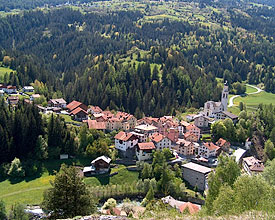
Tiefencastel

The cameramen interviewed me as to my reason for quitting. Other racers questioned me. I waited 30 minutes to see if the second place girl would come, so I could cheer her on and wish her well. But I knew Rolf was shattered and it was time to go. We drove to Davos, the finish line. I showered, power napped for 30 minutes, and walked to the finish line.

One man from the 141k race was in. I saw two more come in over the next two hours. I tried waiting for the first 201 runner, but I just got too cold and tired. I left just after 9 pm and he came in around 10.10 pm. Over 38 hours! I watched the progress from my phone in my room. The first female made it in at 3.30 am - 43.5 hours.

I slept and woke and for a brief moment, I thought, "There's still time to drive back to Tiefencastel and finish the race before the 56 hour cut-off." But that moment passed! ;-) Instead, I went back down to the finish line and watched the presentations and cheered the occasional racer coming in. Only about 25 men and 3 women from the 201 were in. At final tally, they had a total of 31 men and 5 women finish. That's about a 27% finish rate.

I was a bit disappointed with the wording of the media release on the website regarding the male/overall winner, Andreas Allwang of Germany. It read (translated to English, but by my dodgy German still the same) that Andreas was an "amateur" and that the organisation had expected elite men (who were "ultimately lacking" at the race) to finish in times much closer to 32 hours. Though they did acknowledge that the stormy weather overnight took a toll on time predictions. Certainly, my own race predictions fell off the mark when the storms hit. What I thought might have been (very roughly) a 36 hour finish in perfect conditions was surely going to be a 40+ hour finish. For Andreas to hold his race together so well and to finish first in 38 hours in those conditions is no less than elite. Un chapeau, mate.

A day after the event, a dear person told me I was courageous to quit. Pondering that, I thought that courage can only arise from fear. So it could only have been courageous if I had been afraid of quitting. But I wasn't. That remark made me realise how grateful I am that I've reached a point where I know I run for myself and my own joy and not because I'm afraid my self-worth will be called into question if I quit a race. And yes, I still run to inspire others, too, if I can. So, somehow, I hope some will be inspired by the simplicity of my action. I exercised free choice, I was not bound by my ego or by fear. I have no regrets. I'm glad I went to the race, glad I saw those peaks, and glad I quit.

It's just running. It's everything and it's nothing and it's the space between the two.
Pass Digls Orgels - the space between

Thursday, August 8, 2013

This is Different

Race morning. I'm blogging. Where's my usual stress?

In fact, yesterday I developed a rather strange feeling that I just don't feel like racing. I woke with the same feeling. I've never had it before. It's not doubt, fear, apprehension, annoyance with the weather.... I just don't feel like a race today. Just like if one might wake up and not feel like eggs for breakfast.

So, let's see what happens! According to the waiver, I am in perfect mental and physical health.

http://event.tracker.com/Public/DeviceMap/Default.aspx

I'm bib 8, in the "longest and highest single stage mountain race in the European alps." A race that irunfar has determined is the "equivalent to a longer version of UTMB in terms of climb per mile." Does that mean I get an automatic finish time for UTMB, as well? ;)

Thursday, August 1, 2013

Surprise Success in More Ways Than One: The Swissalpine 2013

A few things happened recently in my life that helped shape this race into what it was.

First, I had gone through burn out from being too passionate about too much, saying yes to too many things. That was a terrible time and had a negative impact on my performance at World 24hr in May. I am still far from reclaiming and reinventing the life I want to have (partly because I still need to better define what it is I want and what I'm willing to give up!), but things are certainly much better.

Second, I read a blog post of Timothy Olson's less than a week before the race. He's packed his life up into a car and has hit the open road with his family. This has been a rumbling desire of mine for the past several months. Yes, the idea of the freedom is appealing, but it's also about finding that old hippie of mine and letting her commune with nature again. The one who used to make her own moccasins and pick berries to make jam. So I wanted to run with my hippie nature - to try to enjoy the surrounds more and be more "with" the race rather than seeing it as an adversary to conquer.

Third, I was invited to compete in the Irontrail 201k race, which starts 13 days after Swissalpine. So, Swissalpine suddenly had to become a "taper run." Ummm, yeah, a 78km taper run.

So with all that in mind, I spied the list of female entrants and noted a couple also entered in the Irontrail 201. They were repeat Swissalpine runners and I believe one had run the abbreviated Irontrail 2012 edition (rerouted early, then called off after a half day due to severe weather). I thought I might take the approach of trying to sit just behind/near those females, who were also Swiss locals, provided their pace wasn't too fast for me to feel was sustainable.

The problem was at the start line, I saw only two other "elite" females and neither were those women I wanted to try shadowing. There were about 4 rows of runners still in front of me, perhaps 10 wide, so my view was really limited. I wasn't worried about my starting position, because the first 4km routed us through the wide city streets to allow the group to spread out. I knew I'd be able to settle into my own comfy pace and didn't have to worry about a congo line developing early on. But I couldn't see who all was in front of me and couldn't find my "pacers!" ;)

The other problem was the C42 event and K30 events also started at 7am. So, although I could see two women in front on the first road section, I couldn't see their bibs, worn on the front. I realised one was Lizzy Hawker, as she seems to wear her distinctive blue skirt to events. I was a bit confused as to why Lizzy was within eye sight and didn't expect it to last. I was aiming for top 10, thinking perhaps around 6th was achievable, depending on who showed up, who ran well (including me), the weather, careful pacing to try not to destroy myself for Irontrail....

Early hours, still shady and mild enough.
In my head, thus, I was around 10th place. When I passed Lizzy and another woman before the first major CP (Filisur, 29k), I mentally thought perhaps 8th place. Then another woman went past me and I couldn't read her bib easily from the side to catch her name - I started trying to chase her a bit, hoping that when we passed through Filisur and the timing mats, I would hear her name announced. From her name, I thought I might understand my pacing better.

But she was getting away on me on the descent and I was worried about smashing myself up so early on. Rounding the corner, I saw her peel off into the K30 finish line! Hilarious! Secret racing a girl in a different event! That was a reminder to run my own race and be careful. And what happened as I passed the timing mats? "GermanGermanGerman Bernadette Benson German Australia GermanGermanGerman." I tried to hear a number, but missed it. I looked back at the woman and she held up 4 fingers. My eyes most definitely widened, as I held 4 back up, making sure we were speaking the same sign language! I wasn't sure how to digest that news. Did I go out too hard? Was the heat wave taking its toll on others more than me because of my WA-Summer training? Was there just no depth to the field? I couldn't answer those questions, so decided to just get back to trying to find that hippie that was going to enjoy a gruelling 24k mountain climb in scorching weather.
I'm melting, but at least my gear is comfy! ;)

After the predominantly downhill 29k section to Filisur, it's a 24k climb to Keschhutte, where we are teased by a few km of descent before another climb to the highest point of the race, Sertigpass, at 2,739mtr. Probably around 44k, I passed a bloke who said "GermanGermanGerman." I said, "I'm sorry, only English" (which isn't strictly true, as I can get by with a bit of Spanish, French, and Mandarin, too, but that was too many words to say at the time!). He said, "The third place girl is only just close. You will win her!" (Love the way he translated from German to English!) I replied, "It's a long race, on a hot day" and settled back in to do my thing.

I didn't see her for probably 4km. Then I passed on a steeper section. I figured she must have flat-out speed, but perhaps lacked some hill strength. So it was my chance now to open a gap, as after the summit at 59k, it's 18km mostly downhill to the race finish. That's a lot of time for someone with fast turnover to catch up!

However, the further I got above 2,000 mtr in elevation, the more my world closed in. I found myself walking and didn't remember having to walk at all at the event 3 years ago. Yes, it was a hot day, but that wasn't a complete explanation. It was the lack of altitude acclimatisation. Last time, I stayed nights in Liechtenstein at over 1,700 mtr just before the race, which did help. This time, I chose not to due to costs of hotels and that I knew it was essential I get altitude adjustment for Irontrail. I had to compromise with this one.

I felt like an Everest climber, one foot in front of the other, deep slow breaths. My vision tunnelled and I focused on careful, deliberate placement of my feet so I wouldn't trip. I did not look around at all, for fear of falling over with dizziness. It was totally unlike the last event and unlike TransAlpine Run last year, as well, where I was running up these kind of climbs and loving the views!
Don't even remember seeing the cairn!

My mantra for the last km to Keschhutte became "Get me off this f'in mountain." Hardly Zen! The announcer and mats there indicated that "GermanGermanGerman Bernadette Benson German New Zealand German Third position." So that confirmed it. My nationality had changed, but who's going to complain about an extra star or two at this altitude? I hit the short descent and then saw the last 350mtr climb to Sertigpass. My mantra started up again. I knew every step on the descent would bring me more oxygen. When I got to the aid station at the pass, I grabbed my usual: 1 cup of water to dump over my head, 1 cup of water to dump down my throat, and 1 more cup of water to go, for sipping.

Not carrying hydration on a run of this nature - in this heat - required very careful monitoring. The race organisation is impeccable. There were over 30 aid stations, with aid planned every 2.5 to 7km. And with the heat, they added several more impromptu ones. Plus sprinklers! Amazing on-the-spot planning and the communities got behind it as well. Families came out of their homes with buckets and sponges and sprinklers. I have no idea how, in some places, on the tops of mountains and such, they even got the water to put in the hoses and spray at pressure! But despite dehydration, there's only so much water you can guzzle on procuring it. Too much and you'll puke it instantly! I saw that next to me! But this careful dance meant that despite water at EVERY aid station, plus the hoses, sponges, and sprinklers (on my legs, too, to help cool and prevent cramps), I did not pee once in over 8 hours. To keep systems simple, I chose to go with Hammer gels for the entire race - something I'd never tried before. It worked fine; I would generally crack a gel open just before the aid station, but I went through half my stash within 3 hours! Bites of banana, where available, began to supplement my fuel needs.

Now, back to the summit.... The aid station medicos said, "Bernadette, are you okay?" a couple times as I went by. I would not spare the energy to reply. I knew I was okay and was going to be even more okay when I got to start dropping off the edge of that mountain. If they stopped me, I would have made the effort to answer quickly and coherently, but at that moment, I really just wanted to conserve resources. A quick pause for one more sip, drop the cup, and bang! Over the edge to let gravity help me down to Davos!
Must be another aid station here, as I have another sippy cup!

My back, unfortunately, was not pleased with the jarring. I had a tightened back from just before leaving Perth and funnily enough, it did not improve with 24 hours of flights, sleeping in a strange bed in England, being removed from my sports chiro and massage therapist, and a drive to Switzerland. So, bang bang bang, I jarred my way down the steep descent. But at least with every breath, I felt psychologically better, knowing I was losing altitude.

The course I ran in 2010 had us finishing alongside a river, on the flat and in the open, for quite a while from memory and I remember this feeling like a very long, exhausting section of the race. I was mentally prepared for this. However, the new course (their course from 1986-1997, I think), had us finish predominantly in forest. That was fantastic. I was finally running in solitude, seeing no one in front or behind and it was hot, but shaded. It was hard, but the forest was comforting.

3rd female, 36th overall of 877 finishers in K78
I thought I heard footsteps a few times and kept looking back, waiting for "that girl," then realised my shirt had started to make a crinkly noise near the back of the neck (maybe from being so soaked?). I wondered what I would do if "that girl" caught me into the finish. Would I try to go for it? There was something left in the tank physically, but I didn't know if I truly cared or not. Probably, I would. But again, I decided just to run my pace and address it if it happened. I passed a spectator who smiled broadly and told me in German and with sign language that I was 8th. I knew she must be counting the K42 women, as well, who had started their race at about our 40k mark, at 10.30 am (about the time I passed that town). However, it left a seed of doubt and reminded me not to be greedy about my position and to just accept whatever I'd accomplished.

A drop off the paths into town and a quick 400 metres to the stadium, where I heard them announce, most definitely, Bernadette Benson from Australia was the 3rd female. I ran the half circuit of the stadium. For the first time I can recall on finishing a race, I did not find myself wanting to sprint over the line with a grimace and grunt, with a feeling of, "There! Take THAT you race!" Instead, I remembered where I had come from - the girl who ran 5k alone on bitumen, then the trail runner at the back of the pack, left for dead, who had "one pace" and ran for beer credits. I celebrated the joy of surprise and unknown, the joy of the unpredictability of life. The real success for me in this race was not achieving a podium place, but running with openness. I know no other word to describe it right now.

With my partner in life, running and crime! ;)
After the first "flower ceremony" for podium placers, I found out Rolf's time at Keschhutte (yes, he was doing his longest continuous ultra yet!) and started to make my way back out along the course. There were a lot of hot, suffering faces coming in. It had been a long day in the sun and it was a massive achievement for every one making it to the stadium under their own power. I cheered them all in, offering words of encouragement as best I could. I slowly walked about 2k back up the hill, cheering runners in. I was carrying a giant sunflower I got at the first ceremony and it brought a smile to many of the weathered faces out there. I clapped and reassured them that there was lots of "wasser" and "bier" waiting for them at the bottom. And when I saw my partner, I let out an even bigger whoop of joy!

Four days after Swissalpine, I ran again for the first time. I ran not because it was in my training program, not for beer credits, not because there was someone making me feel guilty, not out of boredom, nor trying to prove something. I ran to feel that fluidity of movement, the beat of my heart through my chest, the smell of the pine forest, the squish of the ground underfoot, the sound of birds, and the peace. I ran to see what might be around that next bend on the trail.

Run with wonder at where it will take you.

Thursday, July 25, 2013

A Play on Toes


Bib 25: http://davos.r.mikatiming.de/2013/index.php?pid=startlist_list

You can search by bib numbers and click any runners to "add to favourites" - should work for the live tracking on Saturday 7 am Swiss time (that's 1 pm Perth or late the night before in western Canada).

Saturday, July 20, 2013

The Seasonal Migration

Other migrating animals have it easy. They just wake up one day, point their beaks or snouts north or south, and away they go! Nothing like humans, who have to figure out what bits of their nest to bring along, arrange others to look after the nest they leave behind, and spend days looking for the best flights (can you imagine a whale analysing jet streams and currents and fish stocks to decide what day to embark on the journey?). Then, because our nests cost money to maintain, there's the matter of accumulating enough of that to last (or bringing some work along, so the migration is essentially pay-as-you-go). And arranging for temporary nests whilst abroad. Can't just show up and build our own!
Goggles, headlamp, and sunnies - signs of a looong run ;)

So, that's where the last month for me got eaten up. High volume training, included. I backed up the 150k week with a 130k + 3800m week, then dropped mileage and added a few speed sessions, whilst keeping brutal strength training, brutal massage, and sports chiro going. The training was a constant joy, allowing me to hit "pause" on the seemingly non-stop arranging and organising and "DOING" of travel preparations. Except, of course, when my running mates would interrupt my interlude with those well-meaning questions, "Sooooo, how's the packing going?"

ACK!

Won't be seeing any "Snottygobble" for a while! (Love them Aussie words)
Training has continued to go well and it's now one week to Swissalpine, race #1 of the season. I'm a bit stuck as to how to approach this one tactically, considering I now have the Irontrail 201 to back up with 12 days later. I think I will take a "cautiously fast" approach...being careful not to destroy myself or unduly risk injury that would prevent me from fronting Irontrail in the best possible condition.

My extra ankle joint I inherited after my collision with the small log/large stick remains. It's the oddest thing, sitting essentially under the retinaculum. It pops out when I point my toes and disappears when I pull them back towards my knee. I get some wide-eyed looks when I demonstrate my new trick! And although it was causing me no grief, the fact that it was still there after nearly a month, with an overseas trip planned wherein I intend to run 201km over what could be 40 hours straight...I finally decided to check in with a foot specialist physio. He torqued my foot in all directions and could really see no reason why I shouldn't go ahead! He figures it's slower to heal because I keep running on it. Fair hypothesis :)

Track session in England's heat wave - even my visor seems to be melting!
With the decreasing running volume, I've been able to fit in a few complementary sessions, including yoga and swimming. Even had a "three-sports-bra day" this week! That was a first!

One more sleep and I'll pack up my jars of cinnamon and turmeric, leave the brambles and nettles of England behind, and head for Switzerland! Tomorrow's short trail run should be in the Champagne region of France. I love Explores!

Monday, June 24, 2013

Running into Nature

With the hills just outside my back door now, it's pretty easy to run into nature. Which is great, because I've decided on a season of trail racing for the "summer" (northern hemisphere summer, that is). It's getting a bit harder for me to be competitive on the trails now, being well flung into my 40s. But trails were my first love and one never forgets their first!

Race plans for the season will have me over to Switzerland first for the Swissalpine 78k on 27 July. This is a race I did back in 2010. I'm not usually one to do a race again, but I was keen to have another crack because it's a very well run, gorgeous race with the alps and cowbells, and fits well with our summer plans. And although older, I am fitter and stronger than that runner from 2010. However, the course has changed I found out, so a direct comparison won't actually be possible! Oh well! The other reason I'm keen to go back is because I happen to be particularly fond of someone who's decided to run the 78k as well and that will be special to share...at the finish line, as we sip on our alkohol-frei beers!
Swissalpine simplicity. A running start and one big climb.

After my three planned recovery weeks post-World 24s, I started ramping up the base mileage. Two weeks ago I hit 110k with +4000 metres of gain for the week. Last week I totalled 150k with +4500 metres! This is a major coup for me, personally. I never used to be able to go over about 85k/week without injury setting in. Over time, that weekly number has steadily inched up. 

I did have a minor setback at Km 52 of my 67k Sunday run, though. A bit of a literal run into nature. I did not heed the blatant example set by one of my running mates earlier in the day...as she demonstrated the inherent dangers of looking back over one's shoulder whilst running single track (I hear her bruises are coalescing and she has about a metre of Fixomul holding her body together). So, at Km 52 I ran my right ankle very firmly into a small but dense log. And then fell over it with full body weight to add a little inversion torque to the Trail Running Lesson of the Day.

Smashed ankle, but it's still a gorgeous day in the bush
I didn't think it was sprained, as I could still weight bear. Over the next few km, I could feel swelling coming on, but chose not to look and focused on maintaining good form so I didn't develop a compensatory injury. Mostly, I noticed that I was losing dorsiflexion. That made braking a challenge on the drive home. For those who don't know their dorsi from their plantar, the dorsi is the "toes up" movement to move your right foot up onto the brake pedal - plantar presses the accelerator. I had go, but no stop!

Anyway, an extra day or two off at this point with ice, Compressport socks, and elevation is likely a good thing for my entire body and may have been Mother Nature's plan all along ;)

But back to the season's racing plans...some of you might be wondering if such crazy mileage is really so essential for a 78k trail race? Certainly, when I look back at 2010, my mileage peaked at 100k (though there was the 201k Sri Chinmoy 24hr 6 weeks before, which was the peak week!).

After chatting to the organisers of the Swissalpine, they invited me to race their quite new IronTrail 201. Now here's the reason for 150k weeks of trail running madness! Irontrail is 12 days after Swissalpine and is 201km of continuous racing with over 11,000 metres of gain up and down over 8 peaks in the Swiss alps at an average elevation over 2000 metres. I sense some Type 2.5 fun coming, with my old pals, Nearer and Further (the Leki poles, remember them??)
IronTrail ECG.

If the body doesn't mutiny after the August race, I'll be fronting up to where it all started back in 2007. The scene of my first ultra, the Lost Soul Ultra in Lethbridge, Alberta, Canada. In September 2007 I ran the 50k. Faster female trail mates of mine didn't. I won. It was a total shock and I vividly recall spending the night on the phone to my mum, drinking whiskey in my room, completely excited, whilst all my mates, exhausted from their own races, slept. Now, I'm thinking it's the perfect place for my first 100 miler. Back in the motherland with the mates who first showed me trail running.
Lost Soul terrain. Hot, dry, steep coulees.

It's now five weeks to race one. The key things that I think have been holding me together are offered for your interest:

avocados, ice baths, Udo's Oil, brutal massage, brutal strength training, Compressport socks, calf guards, full legs, and the new trail shorts (basically, anything compression!), the foam roller, hill running (somehow, more is making me stronger), good long nights of sleep, cinnamon, turmeric, my amazing running mates, healthy home cooked dinners, and sports chiro. And carrots. (Well, I don't know if they can be classified as a super food or anything, but I love my carrots!)

Sunday, June 16, 2013

Just How Phat is a High Fat Diet?

Carbs are out and protein is in.
Fat is out and grapefruit is in.
Eat for your blood type.
Carbs are out and fat is in.
Grain is out and liver is in.
Tapeworms, anyone?

Another case of our human desire for the "quick fix." Because our diet affects weight management, athletic performance, health, and mood, most of us are all too readily excited by new "fads" that come on the market. This applies whether it's a diet to lose weight or a diet as in our "lifestyle" day-to-day diet.

The one that seems to be making its way to my desk/android phone/computer screen/ears the most these days is the high fat diet. It may or may not be "paleo" - the focus is not so much about eating as a caveman, but merely on eating a diet high in fat.

So what's the deal with a high fat diet, from a running athlete's perspective?

Well, the theory is good. We have a limited store of carbohydrate to use as an energy source for exercise. A wee bit, like 5 grams, circulates in the blood. A slightly larger amount, in the range of 60-120 grams (body size dependent), is stored in our liver and provides fuel for the brain. Then, there's the muscle glycogen. The muscles store carbohydrate for use when we exercise. Although it can be increased to some extent in trained athletes and those who are careful to get enough carbs in their diet, particularly replenishing after long runs, there are limits to how much can be stored. Again, women/smaller individuals, with smaller muscles, can store less. The range is something like 200-500 grams. Since 300g is an oft-touted number for a 70kg man, I'm going to guess I'm only able to store closer to 200g.

Look mum, no glycogen stores!
That equates to 800-900 calories for me. Again, most general advice out there is that glycogen stores are depleted after about 1.5 hours of running (less in those less trained). And the "wall" that so many talk about in the marathon...it's just a term for the glycogen "fuel tank" being emptied. At that point, the body is left with two choices: (1) slow down in order to run on fat. And whilst my own body probably has about 9kg of 'excess' fat, which, at 9 cal/g is 81,000 calories, the body converts fat to fatty acid/ATP more slowly than it does carb to glycogen/ATP, so I would have to run slower ... or (2) get some exogenous carbs. That is, eat carbs whilst running. And again, we're limited by how much we can stuff down our throats whilst running hard, without feeling sick (typically less than 240 cals/hr).

Therefore, any endurance athlete would surely want to spare their carbs in storage during a long event and run longer on their fat stores. This concept is known as "carbohydrate sparing" or "glycogen sparing" and a phrase I'm seeing more often lately is "Become a better fat burner!" by going on a high fat diet.

Right. I checked into the research and sure enough, it's true. A high fat diet (70-85% calories/day from fat) induces metabolic changes that do indeed cause us to become better fat burners. When exercising at less than about 60-65% of VO2max, runners burn off less of their stored carbs compared to runners who are on the more typical 65%+ carb diet. They are burning more fat compared to carbs. Their carbs are being "spared." But 65% of VO2max is our LSD pace: 20% slower than marathon or no more than 75% of max heart rate. That's slow.

Anecdotally, I know this. I can go on a long 4 or 5 hour run alone or with mates, at a leisurely pace, even on trails, and eat nothing. Somewhere between 1.5 to 2 hours into the run, I will get a weird hunger pang that I used to think was nausea coming on. I describe it as a feeling kind of like the stomach is trying to eat itself. I used to need to fuel immediately when this came on (if not before, in order to avoid it entirely), as I was less fit and conditioned. So I was working harder at any given pace. In fact, I used to have that feeling come on closer to 1 hour into the run.
Long run Sunday: fueling optional if the pace is easy!

Now, I have more fitness in the legs, lungs, and heart. More base. So I can run an easy pace (less than 75% of max HR) probably all day without eating. However, I just need one mate to push the pace suddenly on a hill and my body screams, "Stop!" Of course, I don't. But I know what it means. It means I'm trying to go from my "neutral" speed where I can effectively fat burn, into gear with lots of low-end torque, where I need faster delivery of fuel. I need carbs or I need to slow down. And my body will slow me down if I don't give it carbs!

But an argument has been made that at least for ultra runners, we are often running at LSD pace. True? Well, that depends on the race distance, training background, and race goals of the runner. And no matter what pace (i.e., heart rate) we start at, after a while, even at the same pace, it won't feel "LSD" anymore! The HR will climb as we heat up and become fatigued. So, either we slow right down to compensate, or we accept that the race gets harder over time. Most of us won't stay below 65% of max through an entire race.

Back to the research. The research then says that although we can actually burn more fat and less of our carb stores up if we go with the high fat diet, it does not result in a performance gain. Yup, that's right. No performance advantage. I found only one study that showed high-fat-diet cyclists were able to cycle longer to exhaustion than high-carb-diet cyclists, but only when the intensity was kept to 60% of VO2max. At a high intensity, there was no performance advantage to being a "better fat burner." Indeed, more studies have reported that those on a high-fat diet report a higher heart rate and greater perceived exertion.

Another other downside to not fueling (with carbs, naturally) during training sessions is that because after 1.5 hours or so when you run out of glycogen, you will not be able to run as fast. How much benefit is there to running every run at less than 65% of VO2max? Gosh, I hope I don't need to answer that one :)

A version of a common graph, showing glycogen depletion within 3 days
Also, if choosing a high fat diet, one will never be able to fill the glycogen stores (after a long run or otherwise). Though research studies have tried to address this by carb-loading the high-fat-diet athletes for 24 hours before their "race" (whatever test they have lined up in the research study), there has still not been a performance advantage for them.

Does this mean fat is bad? No, of course not. Or that carb is king? No, not that, either. But runners do need to keep topping up their glycogen stores if they want to keep making gains in performance, running longer and harder (and enjoying their runs more, too!). It seems to me that the practical approach to take is to figure out our own personal glycogen needs (the size of our own fuel tanks) and then check out our diets to ensure we are getting that much carb in the daily diet. Then, calculate protein needs, and the leftover is fat! (Or more carb and protein if you prefer, but who doesn't want an avocado or handful of walnuts or piece of dark chocolate??)

Although the traditional adage is that 60-70% of our diets (as athletes) should come from carb, this does not take into account individual variations in body size (heavier people have more muscles, so more storage) and training volume (more volume means you're depleting stores more). So, here's how to calculate your own carb needs, summarised and paraphrased by me, from Anita Bean's "The Complete Guide to Sports Nutrition: 6th Edition" - all assuming a 70kg person (so girls like me, reduce!)

If you train "moderately" 3-5 hours per week, you need 4-5g carbs/kg of body weight (per day)
5-7 hours per week...5-6g/kg
1-2 hours/day...6-7g/kg
2-4 hours/day...7-8g/kg
More than 4 hours/day...8-10g/kg

I decided to go with 7 grams for my estimate of carb intake/needs. This week, for example, I exercised for a total of 14 hours, which is an average of 2 hours/day. I am only 52kg, so perhaps I only need 6 grams. But I'll err on the safe side for glycogen storage. So that means I need 364 grams of carbs per day on average (7g x 52kg). At 4 calories per gram in a carb, that's 1456 calories per day from carbs.

How many total daily calories do I need?

Again, referencing Anita's tables, resting metabolic rate in female athletes 31-60 years is (MYWEIGHT x 8.7) + 829. That's 1281 calories (kcals, of course, but I'm just using the generic 'calories' we're all used to).

Sleeping Beauty needed about 1300 cal/day
So no one is left out, the numbers for you guys to do your calculations are...
females 18-30 years = (WEIGHT x 14.7) + 496
males 18-30 years = (WEIGHT x 15.3) + 679
males 31-60 years = (WEIGHT x 11.6) + 879

Once you have your calories necessary to sustain life (mine being 1281), you need to add any for how active you are during the day (before exercise). I sit all day, so I multiply base by 1.4. If you deliver flyers door-to-door all day, you can multiply base by 1.7. If you lay bricks or pound nails all day, multiply by 2.0.

Now I'm up to 1793 cals (1281 x 1.4). And it's time to add the calories I burn during exercise. A sad by-product of getting fit is that I only burn a measly 450 calories per hour on most runs. Add that in to my daily average (450 cal x 2 hr/day average) = 2693 cals/day. There are my needs for weight maintenance, on average. So, back to the carbs - 1456 cal/day - that is 54% of 2693.

Protein. This is simple. 1.6g/kg. So I need 83g/day, which at 4 cal/gram, is 332 cal - 12%. I could even up that a little to be safe, considering I do some strength training. Using 1.7g/kg, I need 88g/day or 352 cal, which is still only 13%.

Fat. The leftover! Knowing I need about 2700 cal/day, 1450 cal should come from carbs to fill up my glycogen stores and 350 cal should come from protein, I am left with 900 cal to come from anywhere I like. So that's up to 33% fat for me personally. At a whopping 9 calories per gram, of course, I am limited to "only" 100 grams of fat. Interestingly, the scientists in endurance athletics recommend 20-33% fat in daily diet. Coincidence that my fat number worked out as it did? I think not. But remember to eat good anti-inflammatory, unsaturated, omega 3 types like those in avocado, salmon, nuts and seeds.

After all this, what are we left with? Gee, the science still supports a balanced diet. Oh, how boring!

P.S. Alcohol isn't in my calculations, as I have no taste for it anymore - just remember it has carbs, plus the alcohol itself is 7 calories per gram.